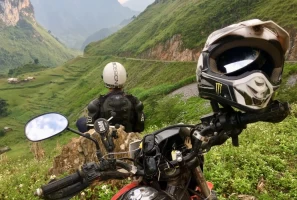
Conquering the Ha Giang Loop is a dream for many international motorbike travelers, but to fully enjoy this iconic route, understanding Ha Giang Loop safety is absolutely essential. In this guide, Frontier Travel Vietnam will help you recognize potential risks, master key riding techniques, choose the right motorbike, avoid dangerous sections, and prepare for your journey like a pro.
.png)
Riders exploring the Ha Giang Loop on mountain roads.
1. Overview of Ha Giang Loop Safety and Why It Matters for Your Journey
Riding in Ha Giang is not an ordinary road trip—it’s a technical ride that demands skill, awareness, and preparation. The route consists mainly of steep mountains, continuous switchbacks, and roads carved into cliffs. Many accidents happen because travelers underestimate the road or overestimate their riding skills.
Understanding safety measures will help you:
- Reduce risks significantly
- Handle unexpected situations
- Feel confident and fully enjoy the scenery
2. Terrain Characteristics & Common Misconceptions
2.1 A Challenging Yet Rewarding RouteNearly 90% of the Ha Giang Loop is mountainous terrain. With narrow roads, tight S-curves, steep climbs, and mixed traffic (cars, trucks, and local bikes), the loop requires focus and proper riding posture.
2.2 Common MisconceptionsMany first-timers believe:
- “The roads look good in photos, so they’re easy.” → Not true.
- “Basic riding skills are enough.” → Incorrect, because mountain riding requires different techniques.
- “Having an easy rider means guaranteed safety.” → You still need to understand the basics to protect yourself.
These misconceptions often lead to preventable incidents.
→ 7-Day Northeast Vietnam Motorbike Adventure: Ha Giang Loop & Hidden Mountain Trails
3. Road Conditions & the Most Dangerous RoadsSome sections of the Ha Giang Loop are classified as dangerous roads due to steep cliffs, frequent fog, or heavy local traffic.
3.1 Tham Ma PassThis pass features nine continuous hairpin bends with steep elevation. Beginners often lose balance from braking too hard or leaning incorrectly.
.png)
Tham Ma Pass – a challenging and dangerous mountain road along the Ha Giang Loop.
3.2 Ma Pi Leng Pass
One of Vietnam’s most stunning passes, but also one of the most dangerous:
- Extremely narrow sections
- One side is a vertical cliff, the other is a deep canyon
- Frequent fog reduces visibility to a few meters
Caution is critical here.
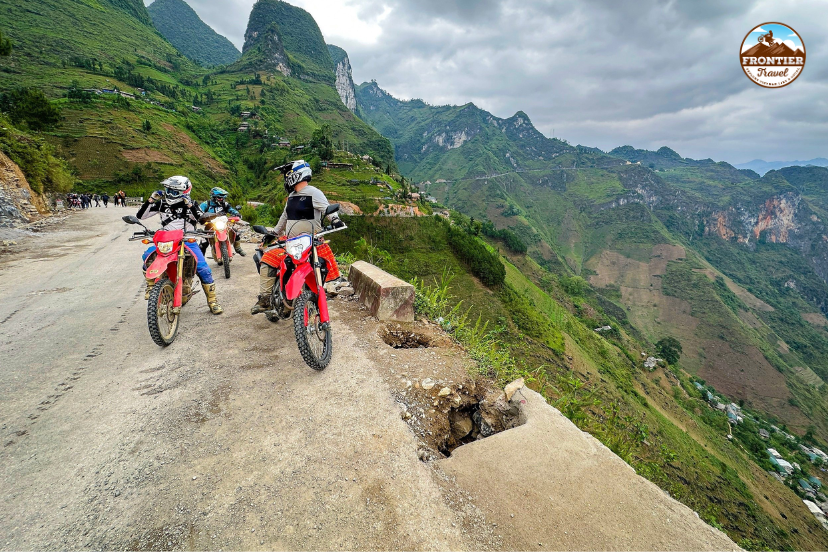
Ma Pi Leng Pass – a section where you must pay close attention to Ha Giang Loop safety.
3.3 Bac Sum PassKnown for long inclines and blind corners. During rainy months, falling rocks and slippery mud make it especially difficult.
.png)
Bac Sum Pass with steep, dangerous curves on the Ha Giang Loop.
4. Weather Risks Throughout the Year
Ha Giang’s mountain climate changes quickly. Understanding seasonal risks is a key part of Ha Giang loop safety.
- June–August: heavy rain, landslides, falling rocks
- October–January: dense fog, cold winds, slippery roads
- February–April: dry but windy, dust on the road
Checking the weather before riding is non-negotiable.
→ Read more Ha Giang Loop Itinerary & Terrain Guide: A Complete 3–5 Day Travel Handbook For International Visitors
5. Mandatory Safety Gear (Big Bike Safety Vietnam)
Whether you're riding a manual motorbike or a 400cc+ big bike, proper gear is essential for injury prevention.
5.1 Helmet Requirements
- Full-face helmet
- DOT/ECE certified
- Clear visor + secure chin strap
.png)
Equip yourself with proper protective gear to ensure your health and safety throughout the trip.
5.2 Protective Clothing
- Motorcycle jacket with CE armor
- Non-slip waterproof gloves
- High-ankle boots
- Armored pants or knee protectors
5.3 Motorcycle Conditions
- Tires must have deep tread
- Responsive brakes
- Strong headlights
- Tight chain and no leaks
Riders using big bikes must be especially careful because the extra weight makes maneuvering more challenging on tight mountain corners. Some of the most popular motorbikes suitable for both on-road and off-road terrain on the Ha Giang Loop include dirt bike models such as the Honda CRF300L, Kawasaki KLX200, Yamaha Tenere 700, and Honda Transalp 750. Riders can also choose to book a guided tour with a reputable organization to make the journey easier, safer, and more enjoyable to conquer.
→ Explore more about suitable vehicle lines for highland travel with Frontier Travel Vietnam
6. Riding Tips for a Safe Ha Giang Loop
These riding tips apply to both beginners and experienced riders.
6.1 Cornering Techniques
- Slow down before entering a bend
- Never brake mid-corner
- Look toward the exit of the curve
- Keep your body balanced
.png)
A group of excited riders on a highland adventure with Frontier Travel Vietnam.
6.2 Riding in Fog
- Use yellow fog lights or low-beam headlights
- Increase following distance
- Stay close to the right edge (mountain side)
- Avoid stopping in the middle of the road
6.3 Overtaking Safely
- Only overtake when visibility is above 50 meters
- Signal with your horn or headlights
- Never overtake on blind corners
7. Renting a Motorbike & Choosing a Safe Tour
7.1 Checklist for Rental Bikes
- Test both brakes
- Check tire wear carefully
- Let the engine idle for 3–5 minutes to detect abnormal sounds
- fill up your tank
7.2 Should You Ride Yourself or Hire an Easy Rider?
- Beginners → hire an easy rider
- Intermediate riders → use a 125–140cc manual motorbike
Avoid big bikes if you aren’t used to steep mountain roads
8. Common Accident Causes & How to Avoid Them
8.1 Riding Too Fast
This is the number one cause of accidents. Many riders get excited by the scenery and unconsciously increase speed.
Solution: Maintain a steady 20–35 km/h, use engine braking, and avoid accelerating after corners.
.png)
Experience travel with diverse mindsets and emotions alongside Frontier Travel Vietnam.
8.2 Oncoming Trucks Taking Your Lane
This happens frequently on narrow corners.
Solution: Stay close to the mountain side and never cut corners.
8.3 Losing Grip on Wet or Muddy Roads
Solution:
- Ride in low gear
- No sudden braking
- Keep your body stable and upright
→ Explore more Ha Giang Loop Motorbike Tour: Complete Guide, Itinerary & Big Bike Tips For 2026
9. Emergency Situations & How to Handle Them
9.1 Minor Falls
- Don’t try to catch the bike with your hands
- Lean with the bike
- Turn off the engine immediately
9.2 Flat Tire
- Use a mini puncture repair kit
- For large damage, call local mechanics or roadside rescue services
9.3 Extreme Fog
- Ride slowly
- Follow the far-right line
Do not stop on the road
10. Real Traveler Experiences (Frontier Travel Vietnam Reviews)
Reviews from frontier travel vietnam reviews consistently show that:
- Technical training before the ride greatly improves confidence
- Newer, well-maintained bikes drastically reduce accidents
- Easy riders significantly enhance safety by signaling hazards ahead
A traveler shared:
“Without my easy rider showing me how to lean into corners, I don’t think I could have finished Ma Pi Leng in thick fog.”
This firsthand feedback reinforces how crucial preparation and guidance are for safe riding.
.png)
Stunning view of the Nho Que River winding through the mountains as seen from the pass above.
11. The Safest 3-Day Ha Giang Loop Itinerary
Day 1: Ha Giang → Quan Ba → Yen Minh
Avoid speeding on Bac Sum Pass.
Day 2: Yen Minh → Dong Van → Ma Pi Leng → Meo Vac
Morning fog is common, so keep your speed low.
Day 3: Meo Vac → Du Gia → Ha Giang
Expect rocky sections; use lower gears.
12. Big Bike Riding Tips (Big Bike Safety Vietnam)
12.1 Why Big Bikes Are Harder
- Heavier weight
- Stronger throttle response
- Lower ground clearance
12.2 How to Ride Big Bikes Safely
- Use smooth riding modes
- Avoid bikes over 400cc if you’re new to mountain roads
Use the rear brake for better stability
13. The Ultimate 30-Point Ha Giang Loop Safety Checklist
Motorbike
- Deep tire tread
- Strong brakes
- No oil leaks
- Bright headlights
- Proper chain tension
Riding Gear
- Full-face helmet
- Motorcycle gloves
- Protective jacket
- Motorcycle boots
- Quality raincoat
Personal Preparation
- Sleep early
- Avoid alcohol
- Bring water
- Download offline maps
- Carry a power bank
Environmental Safety
- Check the weather
- Avoid riding at night
- Don’t ride through falling-rock zones
- Rest every 90 minutes
Don’t take photos near cliff edges
.png)
Safety equipment is always necessary for every trip.
14. Why You Must Experience the Ha Giang Loop at Least Once in Your Lifetime
The Ha Giang Loop is not just a motorbike route—it’s a rare kind of journey that transforms you. While safety is essential, the deeper truth is this: few places on Earth offer the same mix of raw beauty, culture, freedom, and adrenaline as Ha Giang. Here are the reasons why the Loop is a once-in-a-lifetime experience you simply can’t miss:
14.1 The Last Untouched Frontier of Vietnam
Ha Giang remains one of the very few regions in Vietnam that has preserved its wild, rugged landscapes without mass tourism. Jagged limestone mountains, towering cliffs, and deep green valleys create a cinematic backdrop you won’t find elsewhere. Standing on Ma Pi Leng Pass, with clouds drifting below your feet, feels like touching the edge of the world.
14.2 A Feeling of Freedom You Can’t Find Anywhere Else
Riding through endless mountain curves gives you an unmatched sense of freedom. There are no skyscrapers, no crowds, no traffic jams—just you, the bike, and the road. Many travelers describe it as the most liberating experience of their lives.
.png)
A serene sunset on a high hill captured during a journey with Frontier Travel Vietnam.
14.3 Genuine Cultural Encounters
Ha Giang is home to ethnic minority groups such as the H’Mong, Tay, and Dao. You’ll pass through traditional villages, open-air markets, and mountain houses that reflect centuries of culture. It’s a humbling reminder of simplicity, resilience, and connection—something many visitors say changed their perspective on life.
14.4 The Perfect Mix of Challenge and Reward
The Loop challenges you—physically and mentally. Steep passes test your confidence. Narrow curves sharpen your focus. Sudden weather shifts teach you adaptability. But every challenge comes with a reward: a panoramic view, fresh mountain air, a moment of stillness, or a sense of accomplishment that stays with you for years.
14.5 A Journey You’ll Remember Forever
Travelers often say they don’t remember every country they’ve visited—but they always remember Ha Giang. The Loop becomes a story you tell your friends, a memory you revisit, a milestone in your personal journey. It's the kind of trip that shapes you, excites you, and stays with you long after you’ve returned home.
→ What's better than exploring your dream land and connecting with more friends? Check out the 7-day Ha Giang Loop tour of Frontier Travel Vietnam
15. FAQs – Ha Giang Loop Safety & Trip Preparation
1. Is the Ha Giang Loop really dangerous?
Yes. Some sections have narrow mountain passes, sharp turns, and heavy fog, which can be challenging for inexperienced riders. However, if you understand ha giang loop safety, choose the right motorbike, and follow proper riding tips, you can enjoy the loop safely.
2. What should I prepare before riding the Ha Giang Loop?
You should prepare: a certified helmet, riding jacket, gloves, protective boots, offline maps, and ensure the bike’s brakes, tires, and lights are in good condition. Frontier Travel Vietnam provides full bike inspections before every trip.
3. Can beginners ride the Ha Giang Loop?
Yes, but only if you are confident with manual motorbikes. If you’re unsure, it’s safer to hire an easy rider to guide you through the entire journey.
4. Which sections of the Ha Giang Loop are the most dangerous?
The three most challenging sections are:
Tham Ma Pass
Ma Pi Leng Pass
Bac Sum Pass
These areas have steep slopes, hairpin turns, and limited visibility.
5. What type of motorbike is best for the Ha Giang Loop?
A manual motorbike between 110cc–150cc is ideal. Big bikes are possible but only recommended for riders with strong mountain-riding experience. Frontier Travel Vietnam offers high-quality, well-maintained bikes for maximum safety.
6. When is the safest time of year to ride the Ha Giang Loop?
The safest and most pleasant months are March–May and September–October.
Avoid heavy rain season (June–August) and dense fog season (November–January) if possible.
7. What support does Frontier Travel Vietnam provide?
We offer:
Pre-ride safety coaching
Skilled easy riders
Emergency support
High-quality, regularly serviced motorbikes
All designed to enhance your safety throughout the journey.
8. Is it safer to join a tour or go solo?
If you lack experience with mountain roads, joining a tour with an easy rider is significantly safer. Experienced riders may go solo as long as they understand the road conditions and safety rules.
9. Do I need travel insurance for the Ha Giang Loop?
Yes. Travel insurance or motorbike insurance is highly recommended in case of unexpected incidents.
10. Is following ha giang loop safety enough to stay safe?
Following safety guidelines reduces up to 90% of risks, but mental readiness, proper riding habits, and respecting speed limits are equally important. The Ha Giang Loop is incredibly beautiful, but it demands full attention and responsible riding.
Conclusion
The Ha Giang Loop is a bucket-list trip for many travelers, offering dramatic mountains, deep valleys, and a sense of adventure unlike anywhere else in Vietnam. But to fully enjoy the journey, you must understand and apply Ha Giang Loop Safety—from proper gear and riding techniques to route planning and situational awareness.
If you follow the guidelines above, use the right equipment, respect the road, and stay alert, your Ha Giang Loop experience will be both safe and unforgettable.