If you ask anyone who has explored the mountain passes in Vietnam, they will likely give you a long list of stunning routes stretching from North to South. But when it comes to choosing the two most unforgettable passes, the same names consistently rise to the top: Hai Van Pass in Central Vietnam and Ma Pi Leng Pass in Ha Giang.
These two passes do more than represent different regions of the country — they embody two completely contrasting landscapes. One is the gentle harmony of coastal mountains; the other is the raw, dramatic power of a limestone plateau. Their stark contrast creates two experiences that no rider ever forgets.
In this article, Frontier Travel Vietnam dives deeper into why these two routes are so special, why they are mentioned so often, and why every traveler should experience them by motorbike at least once in their lifetime.
1. Hai Van Pass – A Perfect Harmony of Mountains, Sea, and Clouds
Hai Van Pass has long been known by its historic name, “Thiên hạ đệ nhất hùng quan” — meaning “the most magnificent gateway under the sky.” What makes this even more impressive is that the title was given centuries ago, long before cameras or drones existed to capture its beauty. Yet the early travelers who named it somehow understood its greatness instinctively.
Today, with thousands of riders crossing this pass every year, that praise remains undeniably accurate. In fact, Hai Van Pass has been recognized as one of the 10 most beautiful drives in the world, according to Travel + Leisure. Its sweeping coastal curves, shifting weather layers, and dramatic views over the East Sea make it a route that feels both cinematic and unforgettable.
1.1. Its Beauty Is Not Static — It’s the Movement of Nature
The beauty of Hai Van Pass is never fixed. Ride it in the morning and you’ll see sunlight slicing through thin layers of cloud. Visit at noon and the sea opens up in a bright, crystalline blue. Come in the late afternoon and the sun casts a warm, honey-gold glow across Lang Co Bay.
This constant transformation is why many riders say: “No one rides Hai Van Pass twice and gets the same experience.”
1.2. Easy to Ride — But Far From Boring
Hai Van Pass may not be a technically difficult route. Its gradients are gentle, the curves aren’t too sharp, and the road is comfortably wide. But what makes this pass truly unforgettable is its rhythm — the way the landscape rises, turns, and falls in perfect flow.
You start with a climb that suddenly opens into a sweeping ocean view.
Then the road pulls you closer to the mountainside, wrapping tightly around the cliffs.
Moments later, it drops into a long descent lined with deep green forest.
You don’t need to be an advanced rider to feel the thrill of this pass. It’s easy, but never dull. Beautiful, but never monotonous.
→ Read more Hai Van Pass: Ride The Road Between Sea And Sky
.png)
1.3. A Climate Boundary — Where Two Weather Systems Meet
Hai Van Pass sits exactly on the climatic divide between Hue and Da Nang. This means you can start your ride on the Da Nang side under clear, bright sunshine, yet only three to five minutes later, you may find yourself drifting into a pocket of cool, misty fog.
This constant shift creates a sensation as if you’re moving through different “layers of atmosphere,” each with its own mood and temperature.
1.4. Details Most Riders Overlook When Experiencing Hai Van Pass
Fog can appear suddenly and become very dense in the early morning.
The sea below reflects light differently depending on your angle, creating shifting colors throughout the day.
Many of the best viewpoints aren’t located directly on the main road — you need to know exactly where they are to find them.
Sections of the old road still carry marks from wartime history, a reminder of how significant this route once was.
Despite feeling wild and untouched, the pass is only about twenty minutes from the city.
It’s these subtle details that make travelers return to Hai Van Pass again and again.
→ Read more Hai Van Pass: Vietnam’s Most Iconic Motorbike Road
2. Ma Pi Leng Pass – The Raw Power and Untamed Beauty of Vietnam’s Stone Highlands
If Hai Van offers a sense of peace, then Ma Pi Leng delivers something entirely different — a feeling of awe, even shock. This is not a mountain pass you ride for relaxation. It is a pass you ride to wake up, to confront the scale of nature, and to feel your own smallness within it.
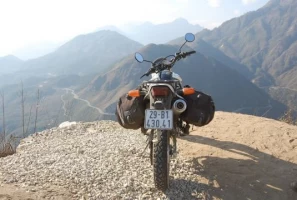
Ma Pi Leng Pass is one of the most dramatic and dangerous mountain passes in Vietnam, carved into the rugged Dong Van Karst Plateau in Ha Giang. Often called the “king of Vietnam’s mountain passes,” it stands as the most iconic and intimidating stretch of the Hà Giang Loop.
The Dong Van Karst Plateau itself is a massive geological region recognized by UNESCO, home to some of the most extraordinary natural landmarks in Northern Vietnam — including Ma Pi Leng Pass, the Tu San Canyon, the Nho Que River, and the Lung Cu Flag Tower.
The entire plateau is often described as a “grey paradise” — a vast world of towering limestone cliffs, jagged rock formations, deep valleys, and peculiar mountain shapes that look almost otherworldly.
→ Read more Top 5 Motorbike Routes Inside Dong Van Karst Plateau 2026
2.1. More Than Beautiful — It’s a Geological Icon
Ma Pi Leng lies at the heart of the Dong Van Karst Plateau, a region recognized by UNESCO as a Global Geopark. This means that everything you see — the layers of rock, the towering cliffs, the sharp limestone ridges, and the deep-cut valleys — is the product of millions of years of geological transformation.
Riding along this pass feels like moving through a massive, open-air geological textbook, where every curve reveals a different chapter written by nature itself.
2.2. Sheer Cliffs — The Sensation of Riding Between Sky and Abyss
The terrain of Ma Pi Leng is unlike any other mountain pass in Vietnam:
- Cliffs rise vertically like massive stone walls.
- The road clings tightly to the mountainside.
- A deep, dramatic canyon drops immediately beside you.
- Some sections are so narrow that a single motorbike and a truck can barely pass each other.
Everything about this landscape pulls you directly into nature’s raw intensity — with no buffer, no gentle transitions, no softness like on Hai Van Pass.
This is why many riders say:
“Ma Pi Leng isn’t a road. It’s a boundary between humans and nature.”
.png)
2.3. The Nho Que River – The Element That Turns the Pass Into a Masterpiece
From the top of the pass, you can see the Nho Que River winding far below. If the ocean softens the beauty of Hai Van Pass, then the Nho Que River is the “emerald ribbon” that completes Ma Pi Leng.
Without the river, Ma Pi Leng would still be spectacular. But with it, the pass becomes legendary.
The contrast between the sheer cliffs and the calm, jade-colored water creates a visual harmony that feels almost unreal — a landscape that many riders describe as one of the most extraordinary sights in Vietnam.
.png)
2.4. A Harsh Construction History — A Value Few People Truly Understand
Ma Pi Leng Pass was built over six years, from 1959 to 1965, entirely by human effort. Tens of thousands of young volunteers from ethnic communities across Northern Vietnam worked with primitive tools, climbing and hanging from cliffs to carve out the road.
The harshness of the terrain combined with the determination of those workers gave this pass a significance that goes far beyond scenery. It is not only a natural wonder — it is a testament to human resilience.
2.5. An Experience Not Meant for Everyone
Unlike Hai Van Pass, Ma Pi Leng demands much more from the rider:
- absolute focus
- confidence in handling narrow mountain roads
- experience navigating tight switchbacks
- a steady mindset, especially for those sensitive to heights
But in return, for those who can take on the challenge, Ma Pi Leng delivers a feeling that no other road in Vietnam can offer — a sense of standing at the edge of something vast, powerful, and deeply humbling.
→ Read more The Complete Guide To Riding Ma Pi Leng Pass By Motorbike
3. Two Mountain Passes — Two Distinct Stories Written by Vietnam’s Landscape
If Vietnam is a country defined by its remarkably diverse terrain, then Hai Van Pass and Ma Pi Leng Pass are two of the most important chapters in that “book.”
Hai Van Pass tells a story of harmony:
- blue ocean
- forested mountains
- drifting clouds
- gentle winds
- soft, sweeping curves
It feels like a painting created with calm, comforting colors.
Ma Pi Leng Pass, however, tells a story of intensity:
- sheer limestone cliffs
- plunging canyons hundreds of meters deep
- fierce mountain winds
- narrow mountain roads
- a landscape so vast it overwhelms the senses
It feels like a sculpture carved into stone by nature over millions of years.
Different as they are, both passes hold a special meaning: they allow riders to understand, more deeply than ever, the true character of Vietnam’s natural world.
.png)
4. Why These Two Passes Became Irreplaceable Icons of the Vietnam by Motorcycle Experience
When people think of motorbike routes in Vietnam, they often picture the Ha Giang Loop, Mu Cang Chai, Da Lat’s pine roads, or the coastal stretch from Nha Trang to Phu Yen. And yet, no two roads are mentioned as consistently — or as passionately — as Hai Van Pass and Ma Pi Leng Pass.
The reasons are simple:
- They represent the two most contrasting landscapes in the country.
- They are symbolic — culturally, visually, and historically.
- The emotional experiences they create cannot be replicated elsewhere.
- Both Vietnamese riders and international travelers consider them “must-ride passes.”
- Together, they offer a complete understanding of the diversity found in all mountain passes in Vietnam.
These two routes are not just scenic; they are essential to the identity of Vietnam’s motorcycling culture.
→ Explore more Epic 7-Day Northeast Vietnam Adventure: Conquer The Ha Giang Loop & Beyond to conquer Ma Pi Leng pass
→ Explore more with Hai Van pass Vietnam In 14 Days: North–South Adventure On The Ho Chi Minh Trail
FAQs
1. Is Hai Van Pass suitable for beginner motorbike riders?
Yes. Hai Van Pass is one of the safest and most accessible mountain passes in Vietnam. Its gentle gradients, wide visibility, and smooth, open curves make it ideal for beginners. However, new riders should avoid riding during heavy rain or dense early-morning fog.
2. Is Ma Pi Leng Pass dangerous?
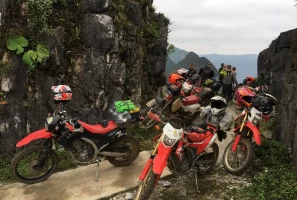
For beginners, yes. For intermediate and advanced riders, it is manageable with caution. The pass is narrow, hugs steep cliffs, includes tight switchbacks, and often experiences strong seasonal winds. This is why Frontier Travel Vietnam usually assigns a local rider or guide to lead the way for better safety.
3. Do I need a driver’s license to experience these two passes?
If you ride the motorbike yourself, you are required to have:
- an International Driving Permit (IDP) 1968
- your valid national license
However, if you sit on the back of a local rider, you do not need a license. This option is safer, legal, and stress-free — especially for travelers who do not meet Vietnam’s licensing requirements.
For a full breakdown of how riding without a license works in Vietnam, including legal rules, risks, and safe alternatives, you can read our detailed guide here: → How to Travel Vietnam Safely Without a License
4. Should I ride Hai Van Pass or Ma Pi Leng Pass first?
If you are not familiar with mountain riding, start with Hai Van Pass to get used to climbing, descending, and handling curves. After that, take on Ma Pi Leng Pass, which requires more confidence and technical control.
5. What is the best season to visit Hai Van and Ma Pi Leng?
- Hai Van Pass: March to August (clear skies, minimal fog)
- Ma Pi Leng Pass: March to October (dry season, best visibility)
6. Are there hidden viewpoints not listed on Google Maps?
Yes, especially on Ma Pi Leng Pass. Many spectacular viewpoints are only known to local riders in Vietnam, discovered over years of riding these mountains. Frontier Travel Vietnam maintains a private list of these viewpoints and shares them only on customized routes.
7. Should I ride Ma Pi Leng Pass on my own if it's my first time in Ha Giang?
It is not recommended. The terrain is too unique and unforgiving for first-timers. The best choice is to ride with a guide or join a group with strong mountain-riding experience.
8. What should I prepare before riding these two passes?
You should have:
- proper protective gear
- strong brakes
- good tires with grip
- a windproof jacket
- gloves
- water
- and the most important: knowledge of the day’s weather conditions
Frontier Travel Vietnam always checks the weather, wind patterns, and fog levels to choose the safest and most scenic departure time.