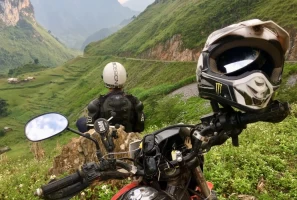
If you are looking for a standard travel checklist, this is not the Ha Giang loop guide for you. The high-altitude highways of Vietnam’s northernmost frontier were built for pioneers, not speed-runners. Rushing through this vertical labyrinth means trading cultural connection and untouched border valleys for raw physical fatigue. To truly dominate these legendary mountain passes, choosing an extended 5-day or 7-day multi-day expedition with Frontier Travel Vietnam is the ultimate game-changer.
1. Introduction to the Ha Giang Frontier
The extreme northern frontier of Vietnam presents an overwhelming sensory transition from flat river deltas to colossal limestone strongholds. Navigating this vertical world demands an immediate shift in personal perspective regarding travel speed, cultural etiquette, and mechanical endurance.
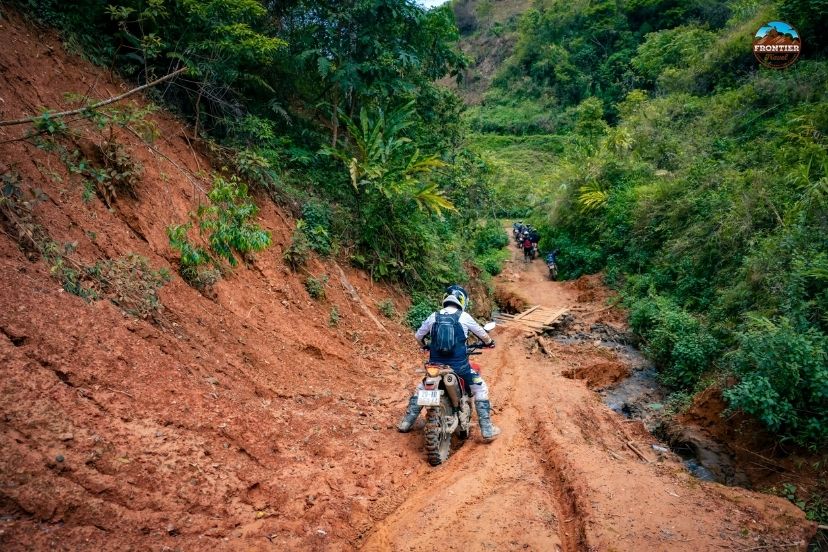
A Ha Giang loop guide prevents navigation errors in remote highlands
1.1. What Is the Ha Giang Loop Guide? Definition and Basics for Beginners
Beginners must calculate true riding times over vertical topographies on Ha Giang Loop Motorbike Tour. At its core, this legendary motorcycling route is a continuous network of national and provincial highways that start and terminate in the provincial capital city of Ha Giang. Covering a standard distance of roughly 350 to 450 kilometers depending on your chosen detours, the loop winds through multiple high-altitude districts along the international boundary line with China.
This circuit requires a definitive Ha Giang loop guide to successfully understand its extreme vertical elevation changes, winding horseshoe curves, and highly variable asphalt quality. Beginners must realize that standard highway velocity expectations do not apply here, as a map distance of fifty kilometers can easily require three hours of intense, focused throttle modulation.
1.2. Geography and Significance
The UNESCO Global Geopark designation highlights colossal limestone karst formations. Any comprehensive Ha Giang loop guide should introduce the majesty of the Dong Van Karst Plateau UNESCO Global Geopark, a protected territory characterized by vast fields of dark limestone needles and steep river canyons. Over 600 million years of geological evolution have left the terrain deeply fractured, creating dramatic 1,000-meter drops directly into pristine river basins below.
This imposing stone landscape serves as the ancestral home of more than twenty ethnic minority communities, including the H’Mong, Dao, Lolo, and Tay groups, who have established villages across the rocky highlands. This rare combination of raw geological power and enduring human culture gives the region its profound global importance.
1.3. The Multi-Day Philosophy: Why Rushing Ruins the Experience
Sustained multi-day mountain driving demands highly structured group pacing. A reliable Ha Giang loop guide should explain why opting for a rushed two-day or three-day express commercial itinerary can turn a magnificent bucket-list journey into a dangerous, exhausting race against the clock. Short sprints force participants to spend up to eight hours daily in the saddle, increasing cognitive fatigue and reducing physical response times on tight hairpin corners.
Furthermore, compressed schedules offer little flexibility to cope with sudden mountain downpours, mechanical failures, or unexpected road washouts. An extended five-day or seven-day timeline provides the breathing room required to venture beyond the main highway, revealing hidden single-track trails and pristine waterfall systems.
2. Essential Pre-Trip Logistics
Securing proper administrative clearances and matching your travel dates with local seasonal patterns are vital steps toward executing a successful mountain expedition. The proximity of the northern loop to international boundary zones means that local authorities maintain strict monitoring systems over foreign travelers.
2.1. Permitting and Legal Requirements
Mandatory frontier entry documents are strictly verified at remote checkpoints on Ha Giang Loop Motorbike Tour. Operating a motor vehicle through the northernmost border districts requires a specialized provincial entry permit issued directly by the Ha Giang Immigration Department. This legal document is strictly required to check into overnight homestays or clear checkpoints in close proximity to the Chinese border line.
Additionally, self-drive travelers must hold a valid International Driving Permit that complies with local transport laws to satisfy regional traffic police requirements. Securing premium insurance validation that explicitly covers high-altitude motorcycle operations is a vital step that should never be ignored before turning the key to begin your Ha Giang loop guide itinerary.
2.2. Choosing Your Travel Window: Seasonal Breakdown
Shifting seasonal weather systems completely transform mountain roadway traction. A detailed Ha Giang loop guide should explain how the visual character and safety profile of the northern circuit evolve across four distinct annual phases, each presenting unique challenges for motorcycle travel. Spring brings soft pastel colors to the valleys as pink peach blossoms and white plum trees bloom against dark stone houses, though heavy morning fog can sharply reduce visibility.
Summer introduces vibrant emerald-green corn crops and roaring high-volume waterfalls, while sudden tropical downpours require reliable tire traction on wet clay roads. Autumn offers clear skies and breathtaking views of golden terraced rice fields cascading down the hillsides, making it an excellent season for photography. Finally, winter brings cold high-altitude winds and pink buckwheat flower fields, requiring warm riding gear to keep hands responsive on the throttle.
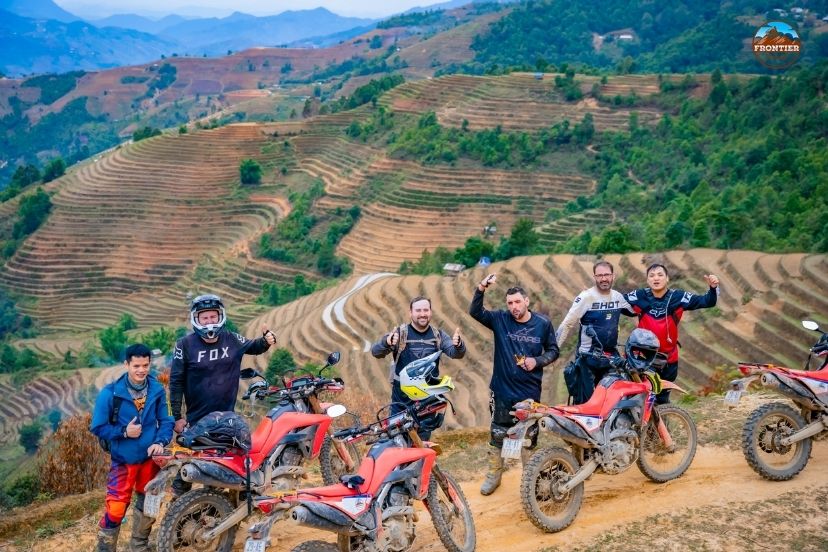
A Ha Giang loop guide supports legal travel through mountain passes
3. Selecting Your Ride: Travel Styles and Fleet Standards
The extreme vertical nature of the northern loop leaves zero margin for substandard machinery or overconfident riding habits. Every participant must make an honest assessment of their personal physical stamina, mechanical experience, and comfort levels regarding high-altitude exposure.
3.1. Easy Rider vs. Self-Ride
Professional pillion drivers handle complex mountain weight distributions with ease. Choosing our professional Easy Rider service allows non-riders and passionate photographers to enjoy the spectacular scenery without the intense mental stress of handling a heavy machine. You sit comfortably on a cushioned pillion seat while a certified, highly experienced local guide handles the complex weight distributions, braking points, and lean angles required for mountain hairpins.
Conversely, selecting the self-drive path demands excellent physical stamina, sharp spatial awareness, and a proven history of handling manual gearboxes on steep inclines. Self-drive operators must maintain total mental discipline for consecutive days to negotiate the relentless gravel switchbacks safely during their personal Ha Giang loop guide journey.
3.2. Motorcycle Selection and Fleet Integrity
Underpowered street scooters present serious brake overheating risks on steep descents. A professional Ha Giang loop guide should emphasize the importance of choosing a motorcycle suited to high mountain terrain rather than relying on a basic 110cc semi-automatic street scooter. Smaller city bikes may provide less suspension comfort, ground clearance, and braking confidence on long climbs, uneven surfaces, and technical downhill sections.
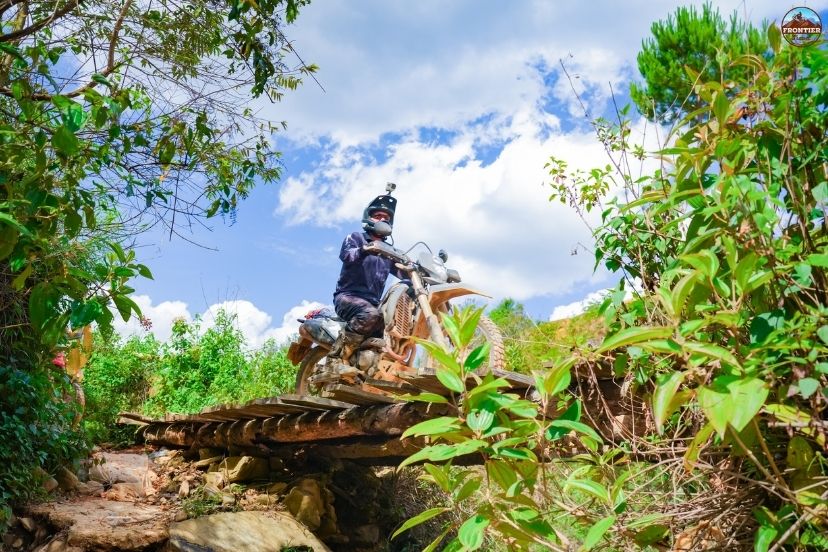
For more demanding routes, adventure-oriented motorcycles such as the Honda XR150 or Honda CRF300L can provide improved ground clearance, spoke wheels, and longer-travel suspension. Combined with regular mechanical inspections and controlled riding speeds, suitable equipment helps riders handle rocky roads, sharp switchbacks, and changing mountain conditions more safely.
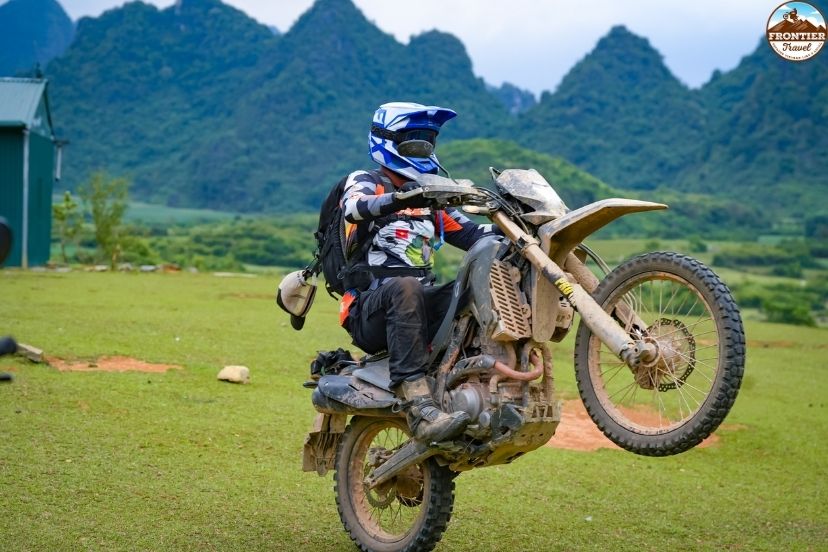
Stable bikes improve mountain pass control
4. The Blueprint: Itinerary Breakdowns
A successful journey through the northern mountains requires an analytical, day-by-day route plan that respects the physical limits of both rider and machine. Frontier Travel Vietnam constructs precise geographical pathways that optimize scenic exposure while maintaining wide safety margins.
4.1. The 3-Day Express Loop (The Incomplete, Rushed Checklist)
Frantic three day timelines omit critical off-road detours entirely. This compressed three-day option acts as a flawed, incomplete travel checklist that forces participants into dangerous riding habits to cover wide geographic distances. Riders are subjected to grueling daily stints in the saddle to hit major towns like Quan Ba, Dong Van, and Meo Vac, leaving zero time for mechanical checks, rest stops, or spontaneous cultural interactions.
This frantic schedule increases your vulnerability to fatigue-induced errors while completely omitting the remote border valleys and hidden trails that define the soul of the region. Rushing through this world-class landscape reduces an epic geographical wonder to a series of stressful, hurried photo stops.
4.2. The 5-Day Northeast Adventure (The Best Overall Balanced Journey)
Extended regional touring seamlessly connects multiple major national preservation zones. This beautifully balanced five-day framework represents the ideal structure presented in our Ha Giang loop guide for exploring the northern provinces without succumbing to physical exhaustion. By avoiding long public bus hauls and starting directly on specialized dual-sport machinery, participants experience a smooth transition from the lowlands into the high mountains.
- Day 1: Hanoi to Thac Ba Lake (Approx. 180 km): The journey leaves the capital city at sunrise to systematically avoid heavy commercial traffic grids. We guide our dual-sport bikes along peaceful, unpaved Red River dike paths, practicing group spacing on loose dirt tracks before arriving at a quiet lakeside White Dao homestay.
- Day 2: Thac Ba Lake to Ha Giang City (Approx. 170 km): Riders head northwest through rolling tea plantations, navigating narrow provincial backroads and local suspension bridges. This stage serves as an excellent warm-up for your suspension systems as the flat lowlands gradually give way to jagged limestone foothills.
- Day 3: Ha Giang City to Dong Van Plateau (Approx. 155 km): The convoy enters the official gates of the UNESCO Geopark, tackling the famous vertical inclines of the Bac Sum and Tham Ma Passes. This demanding stage requires excellent gear discipline to maintain smooth ascents up the nine-turn zigzag hairpin road before we check into our high-altitude Dong Van base.
- Day 4: Dong Van to Meo Vac to Ba Be National Park (Approx. 220 km): After an early run across the spectacular Ma Pi Leng Pass rim, we head down to the river level for a relaxing boat cruise through the deep Tu San Canyon. The afternoon shifts into a long endurance run that travels south out of the stone park and into the dense primary rainforests of Bac Kan province.
- Day 5: Ba Be Lake to Hanoi (Approx. 220 km): The final morning features a peaceful boat ride across the calm waters of Ba Be Lake, navigating directly through the massive limestone arches of Puong Cave. The final afternoon stretch utilizes smooth, modernized national highways to ensure a predictable and safe group return to the capital city by late afternoon.
Veterans and purists who want to explore beyond the classic loop borders can choose our ultimate long-distance expedition. Let us examine the massive seven-day blueprint that connects the high stone plateaus with the magnificent waterfalls of the far northeast.
Planned routes keep group travel safe across districts
4.3. The 7-Day Wild North Expedition (The Ultimate Deep-Country Circuit)
Extended seven day circuits trace historic military supply lines. This massive 1,225-kilometer journey represents the pinnacle of adventure motorcycling in Southeast Asia, connecting multiple remote northern provinces along the Chinese border. The opening three days follow our balanced path up into the heart of the Dong Van Karst Geopark, allowing riders to build solid group communication habits.
- On Day 4, the convoy breaks away from the main loop, heading east along unmaintained single-track border trails toward the isolated mountain town of Bao Lac.
- Day 5 features an incredible ride across the 14-tiered Khau Coc Tra Pass to witness the thunderous roaring cascades of Ban Gioc Waterfall, the largest international boundary falls in Asia.
- Day 6 traces the historic French military paths along Route Coloniale 4 (RC4) into Ba Be National Park, before Day 7 delivers a smooth, successful run back into the capital city to conclude this extensive Ha Giang loop guide operation.
5. Survival and Safety Manual for the Open Road
Conquering the extreme terrain of the far north safely requires an uncompromising approach to roadway discipline, protective equipment standards, and defensive driving techniques. The steep passes and blind corners leave absolutely zero margin for operational negligence or low-quality safety gear.
5.1. Riding Defensive on Mountain Passes
Sounding your horn on blind horseshoe curves alerts oncoming commercial vehicles. A practical Ha Giang loop guide should stress that narrow northern highways are shared with construction trucks, local buses, and roaming livestock that may suddenly appear around blind curves. Maintaining strict lane discipline is vital, and riders should remain safely within their lane on tight bends.
Self-drive riders should use engine braking appropriately rather than relying continuously on friction brakes during long descents, helping reduce the risk of brake overheating. Sounding the motorcycle horn before entering tight blind bends can also alert oncoming drivers to your presence.

Defensive driving protects convoys from road hazards
5.2. Packing and Gear Protocols
Impact rated armor components provide vital skeletal protection against deflections. We enforce a strict protective gear policy across all group departures, requiring internationally certified full-face or dual-sport helmets paired with anti-fog goggles. Your body armor configuration must feature reinforced elbow pads, articulated knee braces, and heavy-duty leather motorcycle gloves to protect your skeletal structure from low-speed falls on gravel sections.
Additionally, mountain weather is highly unpredictable, with temperatures dropping by up to 15°C as you ascend into the high-altitude cloud layers. Packing a lightweight, windproof waterproof layer within your riding pack ensures you stay warm, dry, and mentally sharp on the throttle throughout your customized Ha Giang loop guide expedition.
6. Conclusion
Squeezing a legendary landscape into a rushed, short-day itinerary is the quickest way to rob yourself of the raw, life-changing magic that a definitive Ha Giang loop guide promises. Don't settle for a shallow glimpse of the highlands when you can command the entire horizon pack your grit, leave the complex logistics to the open-road specialists, and book your extended journey with Frontier Travel Vietnam today to turn the throttle on your ultimate northern dream!