Nothing humbles an off-road rider quicker than watching their rear tire sink axle-deep into slick, red clay, making raw riding muddy roads motorbike Vietnam off road tips the ultimate survival manual for backcountry explorers. To help you conquer the wildest, slimiest trails without burning out your clutch or dropping your machine, Frontier Travel Vietnam presents these battle-tested dirt strategies.
1. Realities of navigating unpredictable highland terrain
The dramatic scale of landscape saturation across remote northern borders routinely shocks global adventurers who are accustomed to dry, predictable trail networks. A typical monsoonal weather front releases massive quantities of water within short timeframes, transforming hard packed dirt paths into shifting lanes of deep liquid earth.
1.1. The dreaded highland red clay
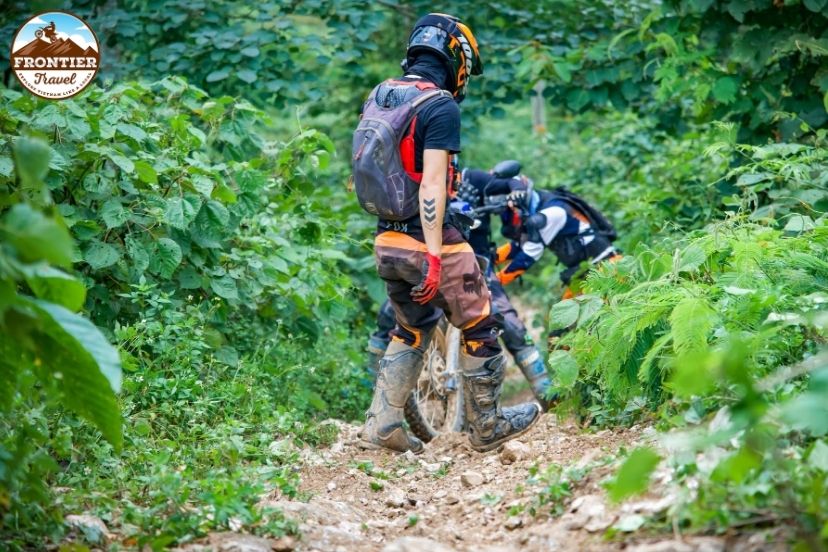
The distinctive red basalt clay found across regions like Ha Giang or Northwest provinces possesses a high percentage of fine volcanic particulate matter. When saturated by seasonal downpours, this unique chemical composition transforms into an incredibly slick paste that sticks heavily to motorcycle components.
The thick muck fills the spaces between aggressive tire knobbies within three tire rotations, instantly turning your off-road tread into a completely smooth surface. This severe loss of mechanical connection requires immediate adjustments to your momentum to prevent your machine from sliding sideways into trailside ditches.
1.2. Riverbed silt and loose topsoil
Venturing through deep valley floors or crossing seasonal streams exposes your motorcycle to layers of fine alluvial silt and saturated topsoil deposits. Unlike sticky clay, this watery compound behaves like a fluid density mass, offering almost zero lateral support for your front wheel assembly.
As your front tire enters this loose sediment, the material pushes aside easily, causing the handlebars to twitch erratically from side to side. Maintaining a consistent forward velocity remains absolutely vital for pushing through these unstable ground sections without losing your balance.
1.3. Evaluating rut depth in the muck
Heavy agricultural tractors and local utility trucks leave deep, parallel trenches along remote unpaved corridors during prolonged periods of heavy rainfall. These deep channels can easily exceed forty centimeters in depth, creating hidden traps that can catch low-hanging engine cases or footpegs unexpectedly.
Off-road operators must train their eyes to evaluate the consistency of the standing water inside these tracks before entering them directly. Choosing the elevated center ridge or a stable grassy edge line often provides a much safer route than diving into unknown tracks.
2. Riding muddy roads motorbike Vietnam off road tips for balance
Minimizing your physical vulnerability across unstable terrain requires adopting an athletic body posture that allows the motorcycle chassis to move independently beneath you. Applying reliable riding muddy roads motorbike Vietnam off road tips regarding body positioning guarantees you maintain control over your vehicle through the slickest sectors.

2.1. The power of standing on footpegs
Standing upright on your footpegs transfers your entire body weight down to the absolute lowest structural points of the motorcycle chassis, which is especially useful during an Ultimate North Vietnam off-road ride. This posture adjustment lowers your effective center of gravity significantly, allowing the machine to pivot naturally beneath your hips over uneven ground.
Keep your knees slightly bent to act as natural shock absorbers, cushioning your spine against sudden subterranean rock impacts. This elevated position also expands your forward line of sight, helping you spot oncoming path obstacles much earlier.
2.2. Look where you want to go
Your motorcycle naturally follows your direct line of sight, meaning the machine will track precisely where your eyes are focused. Fixating your gaze on a deep puddle or a dangerous rock ensures you will likely steer straight into that exact hazard.
Off-road operators must keep their chin parallel to the horizon, scanning five to ten meters ahead to plan their route. Maintaining this forward-looking perspective allows your subconscious motor skills to steer the machine smoothly through the messy ground below.
2.3. Rearward body weight bias
When driving through exceptionally deep, watery mud sections, you must shift your hips backward toward the rear section of the seat. This intentional weight transfer increases downward pressure over the rear tire contact patch, maximizing your available acceleration traction against the slick earth.
Simultaneously, easing the weight off your front forks allows the front wheel to float lightly over obstacles rather than digging in. Keeping your arms relaxed while shifting your weight backward prevents sudden steering deflections from throwing you off balance.
3. Throttle, clutch, and gear selection mechanics
Operating a motorized vehicle across saturated public trails requires discarding aggressive acceleration habits in favor of ultra-smooth, progressive control movements. Abruptly opening the throttle over wet clay will break tire adhesion instantly, causing the wheel to spin uselessly while digging a deeper hole.
3.1. Gear parameters for riding muddy roads motorbike Vietnam off road tips optimization
Selecting the appropriate transmission ratio determines how effectively your engine converts internal horsepower into usable, forward traction. Utilizing a tall second gear allows the engine to operate within a smoother, less aggressive torque band than a touchy first gear.
This reduced gear ratio minimizes the risk of sudden rear-wheel wheel-spin, helping your tires maintain continuous mechanical connection with the earth. Utilizing specific riding muddy roads motorbike Vietnam off road tips keeps your machine tracking forward smoothly through shifting mud fields without stalling out.
3.2. Feathering the clutch for smooth power
The clutch lever functions as your primary traction management tool, allowing you to regulate power delivery to the rear wheel with extreme precision. Off-road riders keep two fingers resting over the lever continuously, slipping the plates within the friction zone to soften sudden engine pulses.
This delicate slipping technique prevents the rear tire from spinning wildly when encountering sudden patches of slick, watery clay. Mastering this tactile control element allows you to maintain consistent forward progress through the most demanding single-track routes.
3.3. Avoiding over revving in deep holes
When your motorcycle loses forward momentum inside a deep mud section, your natural instinct might be to twist the throttle wide open. However, spinning the rear tire at high engine revolutions simply clears away any remaining traction, sinking the chassis down to the swingarm.
If your forward progress stops completely, ease off the throttle immediately to evaluate the situation before burning out your clutch plates. Maintaining a calm, low-RPM approach allows your tire knobs to find mechanical grip along the firmer bottom layers.
4. Machine prep and recovery tactics
Developing exceptional self-preservation instincts involves knowing exactly how to prepare your mechanical equipment before tackling demanding backcountry routes. Attempting to traverse deep monsoon trails on an unprepared street motorcycle increases the probability of mechanical failures or stranded situations.
4.1. Dropping tire pressures for maximum bite
Lowering the internal air pressure inside your inner tubes represents an effective way to increase traction across loose ground. Reducing your pressure from thirty down to approximately fifteen pounds per square inch allows the tire casing to flex and flatten out. This structural deformation expands your active contact patch by nearly forty percent, allowing more knobby rubber to grip the soft terrain.
For longer muddy sections, riders should test pressure adjustments gradually instead of dropping too much air at once. Extremely low pressure may improve grip, but it can also increase the risk of pinch flats, rim damage, or unstable handling when the bike hits hidden rocks. A balanced setup under riding muddy roads motorbike Vietnam off road tips keeps the tire flexible enough for traction while still protecting the wheel during remote trail riding.
4.2. The mud clearing wheel spin trick
When your knobby tires become completely packed with thick, sticky clay, they lose their ability to bite into the terrain effectively. If you reach a short, firmer section of rock or gravel, you can use a brief burst of acceleration to clear the tread channels.
Applying a quick, intentional twist of the throttle causes the rear wheel to spin rapidly, using centrifugal force to fling the packed mud out. This quick cleaning maneuver restores your tire's original traction properties, preparing the machine for the next sloppy segment.
This technique should only be used in short, controlled moments because excessive wheel spin can dig the motorcycle deeper into soft mud. Riders should keep their body weight slightly rearward, point the front wheel straight, and release the throttle as soon as the tread clears. If the tire continues to spin without forward movement, stop immediately and choose a slower recovery method before the rut becomes worse.
4.3. Team recovery protocol for stuck bikes
Extricating a heavy dual-sport motorcycle from a deep mud trap requires an organized group effort to prevent injury or equipment damage. Never allow the stranded rider to pin the throttle while helpers stand directly behind the spinning, mud-slinging rear tire.
Instead, attach a heavy-duty tow strap to the lower triple clamps of the stuck machine, allowing team members to pull forward evenly. Working together in a coordinated manner ensures the motorcycle climbs out of the rut without straining anyone's back muscles.
A safe recovery plan also requires clear communication before anyone starts pulling or pushing the motorcycle. One rider should control the handlebars, another should manage balance from the side, and the remaining helpers should pull from a stable position away from the rear wheel. Following riding muddy roads motorbike Vietnam off road tips helps teams recover stuck bikes efficiently without turning a simple mud trap into an injury risk.
5. FAQ on mastering challenging backcountry tracks
Embarking on a long-distance off-road tour through remote provinces naturally creates critical safety and logistical questions among international motorcyclists. Reviewing these common technical inquiries with verified field data helps clear up ambiguity and sets realistic expectations for the demanding loops ahead. Implementing specific answers regarding riding muddy roads motorbike Vietnam off road tips ensures you stay well ahead of potential geographical challenges before starting your engine.
5.1. Can street tires survive a monsoon trail?
No, standard street tires featuring shallow rain grooves will fail completely within the first five meters of an unpaved highland track. The smooth tread profile lacks the necessary vertical block depth to bite through the slick top layer of clay or silt.
The grooves clog with mud instantly, transforming your wheels into slick, friction-free surfaces that cannot provide lateral stability or braking force. For any serious off-road exploration, outfitting your machine with genuine dual-sport or full-motocross knobby tires remains an absolute necessity.
5.2. How do I prevent a clogged radiator?
Thick clay slung from your own front tire can accumulate rapidly inside the delicate aluminum cooling fins of your motorcycle radiator. This dense mud barrier blocks essential airflow, causing engine temperatures to skyrocket into dangerous overheating zones within minutes of operation.
Installing a heavy-duty, louvred radiator guard prevents large clumps of dirt from packing directly into the cooling core assemblies. It is important to use a low-pressure water hose to flush out any accumulated dirt whenever you stop at rural wash stations.
5.3. What if my clutch slips in deep mud?
If your clutch lever begins to lose its tension or the engine revs freely without transferring power, your clutch plates are overheating. Pull over to a stable side section immediately, shifting the transmission into neutral to allow the engine oil to cool down.
Check your handlebar lever to ensure there is at least two millimeters of free play within the control cable assembly. Allowing the machine to rest for twenty minutes often cools the plates sufficiently to restore proper mechanical friction.
Conclusion
When you apply these specialized riding muddy roads motorbike Vietnam off road tips to your backcountry rhythm, a sloppy, rain-soaked trail stops being a frustrating roadblock and becomes the highlight of your entire dual-sport tour. Conquering these extreme conditions requires the right weapon and local knowledge. Reach out to Frontier Travel Vietnam today to rent our torque-heavy, mud-ready dual-sport fleet and get custom trail maps designed to test your limits safely.