Skipping a proper motorbike tire pressure off road Vietnam adjustment guide checklist before you dive into the wilderness is a quick way to lose traction, dent your rims, or suffer a sudden pinch flat miles away from help. To help you transform punishing scree fields and slippery single-tracks into a fluid, manageable flow, the trail veterans at Frontier Travel Vietnam have built the ultimate guide to micro-adjusting your PSI for any off-road scenario.
1. The physics of dropping PSI on unpaved tracks
Deflating your motorcycle tires below standard street specifications alters the entire pneumatic behavior of the machine over rough terrain. On paved highways, a high pressure of 32 to 36 PSI keeps the tire profile round to reduce rolling resistance and maximize fuel efficiency. Implementing a calculated motorbike tire pressure off road Vietnam adjustment guide routine allows the tire to act as a functional extension of your motorcycle’s suspension system.
1.1. Expanding the tire footprint area
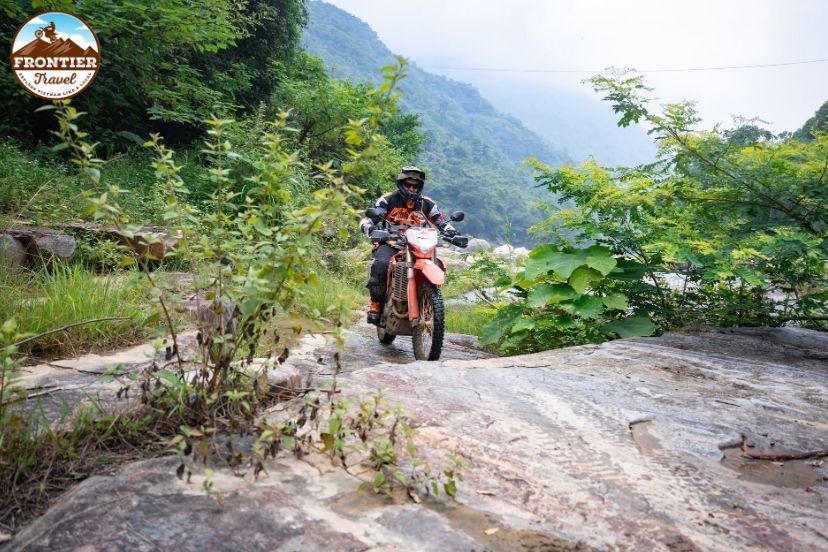
Dropping your rear tire pressure from 32 PSI down to 14 PSI increases the overall surface contact patch by over 150 percent. This wider footprint distributes the total weight of the motorcycle and luggage across a much larger surface area, preventing the rear wheel from digging a deep hole in soft terrain. On loose silt or river gravel, a wider footprint allows the tire to float along the top layer of material rather than sinking into it. This expanded traction profile provides the necessary lateral stability to prevent the rear end from fishtailing during sudden throttle inputs.
1.2. Allowing the carcass to flex smoothly
A flexible tire carcass molds itself around jagged obstacles rather than resisting them with rigid pneumatic force. When an under-inflated tire hits a 10-centimeter rock shelf, the tread deflects inward, wrapping around the stone to grab mechanical traction.
This wrapping effect prevents the entire wheel assembly from being deflected sideways, keeping your chosen line straight and predictable. Utilizing this carcass flexibility reduces the physical work required by your front forks, saving your internal valving from premature wear over long tours.
1.3. Maximizing mechanical grip on loose soil
Mechanical grip relies on the individual knobby blocks biting deeply into the loose topsoil to propel the machine forward. When the tire pressure is adjusted using a structured motorbike tire pressure off road Vietnam adjustment guide, the individual knobs spread outward from one another, creating larger channels to scoop away loose debris.
This self-cleaning action prevents thick clay from packing tightly between the tread blocks, which would turn the tire into a slick racing slick. Maximizing this mechanical connection allows you to climb 30-degree slippery inclines without losing crucial forward momentum.
2. Motorbike tire pressure off road Vietnam adjustment guide by terrain
The diverse geography of Vietnam requires riders to constantly monitor and alter their inflation strategies as they move between distinct geological zones. Carrying an accurate low-pressure digital gauge allows you to make precise adjustments as the trail conditions shift from mud to rock. Following a systematic motorbike tire pressure off road Vietnam adjustment guide ensures your dual-sport bike remains perfectly set up for whatever hazard appears past the next river bend.

2.1. Ultra low pressures for slick mud
When encountering the notorious red clay trails of Lao Cai after a monsoon downpour, dropping your tire pressure to extreme levels is mandatory for safer Off-Road Thrills. For a standard 120-kilogram dual-sport bike, reducing the rear tire pressure to 11 PSI and the front to 12 PSI creates the massive contact patch required to grab traction.
This ultra-low inflation allows the tire to flatten out completely, forcing the side knobs to dig into the soft ruts for lateral stability. You must maintain smooth throttle transitions at this pressure to avoid spinning the rim inside the tire bead.
2.2. The safe inflation for sharp limestone
The jagged karst limestone formations of the northern loops present a massive threat to lightweight aluminum rims and standard inner tubes. To counter this hazard, this motorbike tire pressure off road Vietnam adjustment guide recommends keeping your pressures higher, between 18 PSI front and 19 PSI rear.
This increased air volume provides a stiff pneumatic cushion that prevents the tire from compressing completely to the rim when hitting a sharp 15-centimeter rock ledge at 40 km/h. This setting preserves your steering accuracy while offering excellent protection against sidewall slashing.
2.3. Managing deep sand and riverbed gravel
Crossing the wide, sandy riverbeds of the Central Highlands requires a tire pressure configuration that maximizes flotation to prevent burying the rear axle. Dropping both the front and rear tire pressures to a flat 13 PSI allows the machine to skim across the top of moving sand grains smoothly.
A soft front tire prevents the front end from plowing into the sand, allowing the handlebars to remain light and responsive in your hands. This specific setting allows you to maintain a steady 40 km/h pace across deep river gravel without the front wheel hunting side-to-side.
3. The dark side of low pressure: Avoiding trail damage
Failing to balance your tire pressure with your actual riding speed will quickly lead to structural wheel failures. A heavy hit on a sharp boulder with an under-inflated tire will pinch the inner tube between the rock and the rim flange, causing an instant flat. Incorporating the preventive steps outlined in this motorbike tire pressure off road Vietnam adjustment guide protects your tubes and keeps your wheels perfectly round over thousands of kilometers.
3.1. Understanding pinch flats on tubes
A pinch flat, often called a snakebite, occurs when the tire carcass compresses completely down to the metal rim under a heavy impact load. This severe compression pinches the rubber inner tube between the two hard surfaces, punching two distinct holes that cause instant deflation.
To prevent this common trail failure, riders using standard 1.5mm thin tubes must never drop their pressures below 15 PSI on rocky tracks. Upgrading to 4mm heavy-duty vulcanized rubber inner tubes provides the structural thickness needed to survive these extreme compression impacts without puncturing.
3.2. Preventing severe rim damage from rocks
An under-inflated tire exposes the soft aluminum rim flanges of your motorcycle to direct structural impacts from large, embedded stones. Hitting a vertical ledge with only 12 PSI of air pressure can easily bend the rim lip inward, breaking the bead seal on tubeless tires or breaking spokes on tube-type wheels.
A bent rim creates a dangerous wheel hop at highway speeds and requires a hydraulic press or a trailside hammer to repair. Maintaining a minimum of 17 PSI on unknown, high-speed rocky tracks is the best insurance policy against destroying an expensive wheel set.
3.3. Motorbike tire pressure off road Vietnam adjustment guide for tire spin
When internal air pressure drops below 15 PSI, the friction holding the tire bead against the inside of the rim flange is greatly reduced. Under heavy acceleration or aggressive front braking, the massive mechanical torque can cause the metal rim to spin completely inside the rubber tire carcass.
This rotational slippage instantly tears the brass valve stem off the inner tube, resulting in an immediate, unrepairable flat tire. To prevent this catastrophic failure, this motorbike tire pressure off road Vietnam adjustment guide emphasizes installing mechanical rim locks before lowering pressures.
4. Essential tire management gear for remote border loops
A complete tire maintenance kit allows you to maintain total self-sufficiency when exploring isolated jungle tracks along the frontier borders. You must choose tools that can withstand continuous vibrations inside your luggage without losing their calibration accuracy. Having these tools ready allows you to execute every recommendation found in this motorbike tire pressure off road Vietnam adjustment guide with absolute precision.
4.1. Carrying a reliable low pressure gauge
Standard automotive tire gauges are calibrated for high pressures and cannot accurately read subtle changes between 10 PSI and 15 PSI. You must carry a dedicated off-road dual-sport pressure gauge that features a clear, low-increment scale from 0 to 30 PSI.
A digital gauge with a backlit display allows you to make accurate micro-adjustments in low-light conditions or deep forest canopies. Checking your pressures every morning before the tires heat up from riding ensures your baseline measurements remain completely accurate.
4.2. Choosing portable pumps and compressors
Once you finish a technical off-road section, you must re-inflate your tires back to highway pressures before hitting the hot pavement. A compact, 12-volt electric air compressor that connects directly to your motorcycle's battery provides effortless inflation in less than three minutes per tire.
If you prefer a lighter setup, a dual-action aluminum hand pump offers a reliable, battery-free backup that fits easily inside a standard hydration pack. In any motorbike tire pressure off road Vietnam adjustment guide, carrying a few 16-gram compressed CO2 cartridges is also recommended for instantaneous inflation during rapid tube changes on the trail.
4.3. When to install heavy duty rim locks
A mechanical rim lock is a rubber-coated aluminum wedge that bolts through your rim, clamping the tire bead firmly against the wheel frame. If your itinerary involves tackling deep mud or loose mountain scree where pressures must drop below 14 PSI, installing rim locks is absolutely mandatory.
This mechanical clamp allows you to utilize single-digit pressures safely, maximizing your traction without the risk of tearing your valve stems off. Note that rim locks add significant weight to one side of the wheel, requiring lead balancing weights to prevent high-speed wheel wobble on the pavement.
5. FAQ on adjusting off-road motorcycle tire pressures
Navigating the transition between high-speed highways and technical mountain single-tracks raises many practical questions regarding proper tire inflation management. Many riders are unsure how far they can safely push their tires before risking structural damage or bead separation on remote loops. Below are the most critical pressure-related questions answered by professional backcountry guides who manage fleet motorcycles across extreme terrain every day.
5.1. Can I ride highways with low PSI?
Riding on paved highways with off-road pressures below 15 PSI is highly dangerous and should be avoided at all costs. The low pressure causes the tire sidewalls to flex excessively at high speeds, generating extreme internal heat that can delaminate the rubber tread layers.
This excessive heat buildup softens the tire carcass, causing the bike to wander vaguely across the lane and drastically increasing braking distances. Always use a portable pump to bring your pressures back up to a minimum of 28 PSI before initiating long, high-speed asphalt transits.
5.2. Do tubeless adventure tires require pressure shifts?
Large adventure motorcycles equipped with tubeless rims follow a completely different set of pressure guidelines than lightweight tube-type dual-sport bikes. Tubeless tires rely entirely on high internal air pressure to wedge the stiff rubber bead against the safety ridges of the aluminum rim.
Dropping a tubeless tire below 22 PSI on a heavy 200-kilogram machine can cause the bead to unseat completely during a hard lateral impact, causing an instantaneous loss of all air volume. Following a motorbike tire pressure off road Vietnam adjustment guide helps riders keep tubeless adventure tires inflated between 24 and 26 PSI for off-road use to maintain a secure bead seal.
5.3. How to re-inflate tires without shops?
When you emerge from a remote jungle track miles away from civilization, you cannot rely on finding a local mechanic with a working air compressor. Carrying your own dedicated inflation equipment, such as a compact electric compressor or a high-volume mountain bike hand pump, is the only reliable solution.
If your electric pump fails, you can use a basic hose adapter to bleed pressurized air from a companion's tire into your own to equalize the pressures. This self-reliant approach ensures you can always safely return your tires to highway specifications before traveling on paved mountain switchbacks.
Conclusion
A smart motorbike tire pressure off road Vietnam adjustment guide is not just about lowering psi. But about understanding how each trail surface changes the way your bike grips, turns, and absorbs impact. From muddy jungle tracks to sandy riverbeds and sharp highland rocks, the right pressure helps riders stay more stable, protect their tires, and ride with better control. Ride with Frontier Travel Vietnam to experience real off-road routes with expert guidance and safer trail preparation.