Understanding the balance between the legal motorbike speed limit Vietnam mountain road safe speed and real-world road conditions is the secret to conquering the country's northern loops without incident. To keep you moving efficiently while staying fully within the law and your own comfort zone, Frontier Travel Vietnam has designed this practical velocity guide for mountain touring.
1. Legal rules for mountain motorcycle speeds
National transportation statutes establish clear maximum velocity parameters for two-wheelers operating outside major metropolitan boundaries. On standard two-lane highways outside residential districts, motorcycles are legally permitted to travel at a maximum speed of sixty kilometers per hour. However, when entering densely populated villages or commercial townships, the statutory threshold drops immediately to forty kilometers per hour. These specific numerical boundaries are clearly displayed on circular white regulatory signs featuring a bright red border line.
1.1. Why the maximum legal limit is often way too fast for tight hairpins
While traveling at sixty kilometers per hour is perfectly legal on straight valley stretches, attempting to maintain this velocity through alpine switchbacks is extremely dangerous. The tight radius of a typical mountain curve reduces the maximum stable cornering speed to less than thirty kilometers per hour.
Maintaining excessive entry speed forces the operator to brake abruptly while leaning, which easily triggers a low-side slide on the pavement. Reviewing basic motorbike speed limit Vietnam mountain road safe speed variables helps riders understand why legal allowances often exceed the boundaries of real-world safety on structural gradients.
1.2. Understanding how local traffic police monitor speeds in remote valleys
Provincial traffic safety departments maintain a visible presence along popular tourist circuits to perform systematic velocity audits using digital radar equipment. Officers establish tactical checking points just outside residential boundaries where the legal threshold transitions from sixty down to forty kilometers per hour.
These law enforcement units utilize calibrated handheld laser speed guns to record approaching vehicles from completely hidden roadside positions. Staying strictly within the posted numerical speed boundaries protects your travel funds from expensive moving violation citations.
2. Deciding your tactical safe highland pace
Operating a motorized vehicle across saturated public roadbeds requires discarding aggressive acceleration habits in favor of ultra-smooth, progressive control movements. Saturated asphalt surfaces suffer a dramatic reduction in friction coefficients, expanding your total required stopping distances by more than forty percent.
2.1. The ideal speed bracket for navigating blind curves and switchbacks
Experienced adventure motorcyclists maintain a disciplined operational bracket between twenty-five and thirty-five kilometers per hour when cornering along remote loops. This measured velocity allows the rider to remain centered within their designated lane without drifting into oncoming traffic pathways.
Furthermore, keeping your speed within this conservative range gives you a generous three-second reaction window to handle sudden hazards. Adhering to a conservative motorbike speed limit Vietnam mountain road safe speed ensures you can bring the machine to a complete stop if an obstacle appears.
2.2. Adjusting your velocity when trailing behind slow-moving heavy trucks
Multi-axle cargo trucks climbing high-altitude slopes move at incredibly slow speeds, often under fifteen kilometers per hour, while emitting heavy diesel exhaust clouds. When trailing these slow-moving vehicles, maintain a generous twenty-meter following distance to stay visible within the driver's side mirrors.
Never attempt to pass a heavy truck until you have a completely clear forward view on a straight highway segment. Applying smart motorbike speed limit Vietnam mountain road safe speed tactics means matching the truck's slow pace until passing becomes completely secure.
2.3. Why dropping your speed by half is mandatory during heavy high-altitude fog
Thermal mountain fog can instantly reduce your horizontal field of vision to less than three meters along high-altitude sections of provincial routes. Under these extreme visibility constraints, operators must reduce their cruising velocity to less than twenty kilometers per hour immediately.
Traveling at this ultra-low speed ensures your stopping distance remains well within your highly restricted forward line of sight. Adopting a highly reduced motorbike speed limit Vietnam mountain road safe speed profile prevents dangerous frontal collisions with unseen roadside objects.
3. Technical factors that dictate your speed
Minimizing your physical vulnerability during heavy monsoonal weather requires adapting your personal apparel layout to isolate your body from external moisture. High-quality wet-weather gear functions as an essential structural barrier that preserves your physical endurance and mental focus over long riding hours. Many independent travelers compromise their safety by failing to upgrade their protective gear before encountering intense tropical storm systems. Investing in proper, waterproof equipment configurations guarantees your body remains dry and resilient against changing environmental elements.
3.1. Engine selection for motorbike speed limit Vietnam mountain road safe speed optimization
Climbing into the massive step-topography of the northern border provinces introduces demanding technical challenges that test the physical endurance of your bike. Standard 110cc automatic scooters lack the necessary gear-reduction capabilities to utilize engine compression braking effectively during steep downhill runs.
Operating a proper manual machine allows you to lock the transmission into a low second-gear ratio, which regulates momentum naturally. This mechanical drag configuration keeps your speed controlled without placing excessive thermal stress on your brake pads.
3.2. Gauging corner entry speed to avoid washing out on loose roadside gravel
High-altitude mountain segments regularly accumulate thick patches of fine limestone dust, loose gravel, and agricultural debris along outer cornering lines. Entering these contaminated zones with excessive velocity destroys tire adhesion instantly, causing the front wheel to wash out outward.
Operators must complete all necessary deceleration work before initiating their leaning angle into any mountain curve. Maintaining a calculated motorbike speed limit Vietnam mountain road safe speed allows the motorcycle to cross over loose debris patches while remaining completely upright.
3.3. Managing braking distances on wet, mossy asphalt after a storm
Saturated asphalt surfaces experience a severe drop in friction coefficients, expanding your required stopping distances by more than forty percent. High-altitude routes that remain shaded by dense cliff faces frequently harbor patches of wet green moss that are slicker than ice.
Squeezing the brake levers abruptly under these low-traction conditions will cause immediate wheel lockups and subsequent chassis instability. Keeping your pace aligned with a defensive motorbike speed limit Vietnam mountain road safe speed ensures you never need to apply emergency braking force over these dangerous sections.
4. Road hazards that require instant braking
Developing exceptional self-preservation instincts involves knowing exactly when environmental conditions have surpassed the safe operating limits of a two-wheeled vehicle. Continuing to drive through extreme weather events out of a desire to stick to a rigid itinerary represents a dangerous safety gamble. Frontier Travel Vietnam encourages a flexible approach to route management, emphasizing that waiting out a severe storm front is always the smart operational decision.
4.1. Spotting wandering livestock and slow agricultural tractors early
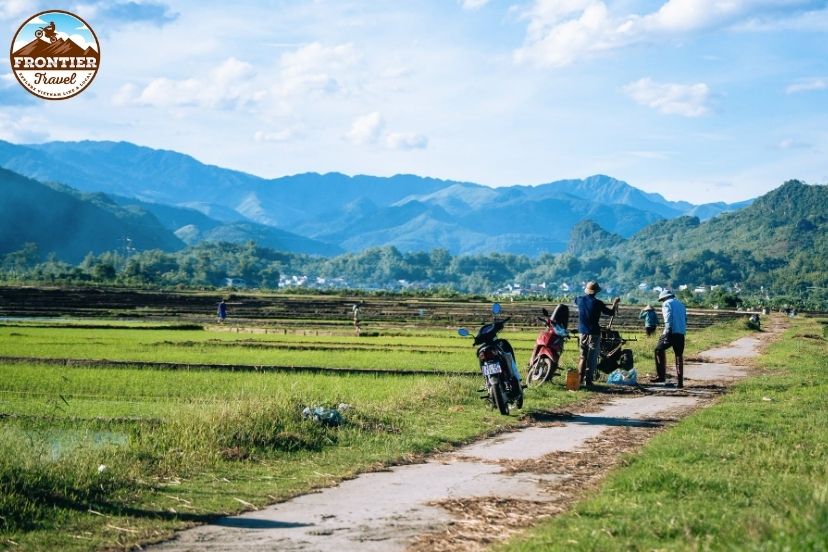
Remote highland routes pass directly through ancestral farming territories where domestic livestock roam freely across the public asphalt. Buffalos, mountain goats, and local hunting dogs will regularly congregate along blind corner apexes to escape the dense roadside brush.
Furthermore, unlit agricultural tractors moving at under ten kilometers per hour frequently enter the highway from hidden mountain paths without warning. Maintaining an observant, low-velocity motorbike speed limit Vietnam mountain road safe speed strategy ensures you can navigate safely around these unpredictable biological obstacles without swerving erratically.
4.2. Anticipating local riders cutting corners from oncoming blind lanes
Commuters native to the highland regions frequently operate their small utility scooters without utilizing headlights or observing official lane boundaries. These riders will regularly cross over the double yellow center line to cut through blind hairpins along the shortest possible path.
Motorcyclists must approach every blind turn under the assumption that an oncoming vehicle is currently occupying their lane. Maintaining an ultra-conservative motorbike speed limit Vietnam mountain road safe speed provides the necessary safety margin to avoid these oncoming lane intrusions.
To reduce this risk, riders should position their motorcycle closer to the outer edge of their lane before entering a blind curve, giving extra room if another rider cuts across the center line. Avoid leaning aggressively into corners where visibility is blocked by cliffs, trees, or parked vehicles. A short horn signal before tight hairpins can also alert unseen traffic and create a safer passing buffer on narrow mountain roads.
4.3. Approaching unpaved road construction zones and deep mud patches safely
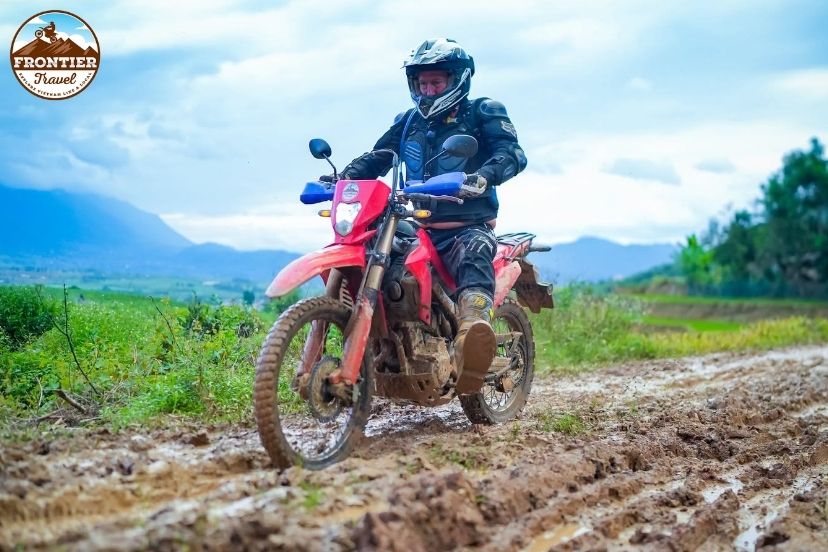
Provincial infrastructure improvement initiatives regularly convert long sections of highland highway into active, unpaved construction zones filled with sharp crushed stone. These rugged construction sectors feature deep mud ruts and unstable gravel beds that challenge the balance of any two-wheeled machine.
Motorcyclists must reduce their velocity to first-gear crawling speeds, keeping both feet hovering just above the footpegs for immediate balance adjustments. Utilizing a patient motorbike speed limit Vietnam mountain road safe speed approach ensures your tires can roll through shifting terrain surfaces without getting stuck.
When crossing muddy or loose sections, riders should avoid sudden throttle bursts, hard braking, or sharp steering inputs because these actions can quickly break tire traction. Instead, maintain a steady grip, look ahead toward the firmest visible track, and allow the motorcycle to move slightly beneath your body without panic. If the mud becomes too deep or the gravel layer feels unstable, stopping to inspect the surface before continuing is far safer than forcing the bike through at speed.
5. FAQ on maintaining a safe touring pace
Embarking on a long-distance motorcycle tour through tropical regions naturally creates critical safety and mechanical questions among international travelers. Reviewing these common technical inquiries with verified field data helps clear up ambiguity and sets realistic expectations for the demanding ride ahead. Understanding these specific operational parameters ensures you stay well ahead of potential weather challenges before starting your journey.
5.1. Do local speed traps exist on famous loops like Ha Giang?
Yes, provincial traffic safety departments establish regular speed enforcement zones along the flat approach roads leading into Ha Giang City. Officers utilize advanced digital radar cameras to monitor incoming traffic flows, issuing strict monetary citations to any operators exceeding forty kilometers per hour.
While active speed traps are less common on the high mountain passes themselves, maintaining a conservative pace remains essential due to natural hazards. Adhering strictly to a legal motorbike speed limit Vietnam mountain road safe speed protects your travel funds from unexpected fines.
5.2. What is a realistic daily distance to cover when riding safely?
When navigating complex mountain passes safely, independent motorcycle travelers should aim to cover an absolute maximum of one hundred and twenty kilometers per day, especially during long On-Road Adventures across northern Vietnam. While this distance sounds short on paper, completing this mountain journey requires between six and seven hours of active operating time.
The continuous sequence of tight switchbacks, steep inclines, and mandatory hazard decelerations reduces your true average speed to roughly twenty-five kilometers per hour. Integrating a practical motorbike speed limit Vietnam mountain road safe speed into your itinerary ensures you reach your overnight destination safely.
5.3. How do I maintain a steady pace when riding with a large group?
Maintaining a safe, collective velocity within a motorcycle touring group requires implementing a staggered formation with clear internal signaling protocols. The most experienced rider must occupy the lead position, setting a conservative pace that matches the capabilities of the least experienced member.
Each subsequent rider maintains a two-second safety gap behind the machine directly ahead, preventing dangerous bunching behavior during sudden braking phases. Utilizing an established motorbike speed limit Vietnam mountain road safe speed framework ensures the entire group adjusts its momentum smoothly.
Conclusion
Mastering the motorbike speed limit Vietnam mountain road safe speed dynamics isn't about rushing to the next viewpoint; it's about riding at a pace that allows you to react to the unexpected. You don't have to navigate these challenging elevation changes alone or unprepared. Connect with Frontier Travel Vietnam today to get equipped with premium adventure bikes and professional route advice designed to keep your mountain journey perfectly paced and exceptionally secure.