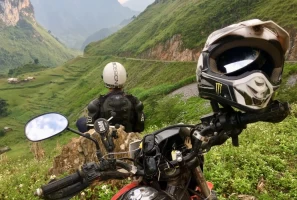
For many, learning how to ride motorbike mountain passes Vietnam tips is the dividing line between an overwhelming, stressful ordeal and the most exhilarating road trip of their lives. To help you transform these intimidating alpine ascents into your personal playground, Frontier Travel Vietnam has broken down the exact physics and tactical maneuvers required to master the peaks.
1. The physics of ascending and descending steep grades
Climbing into the massive step-topography of the northern border provinces introduces demanding technical challenges that test the physical endurance of your bike. Mastering these fundamental control elements establishes a solid foundation for avoiding common high-altitude operator errors.
1.1. Managing weight distribution when climbing sharp vertical inclines
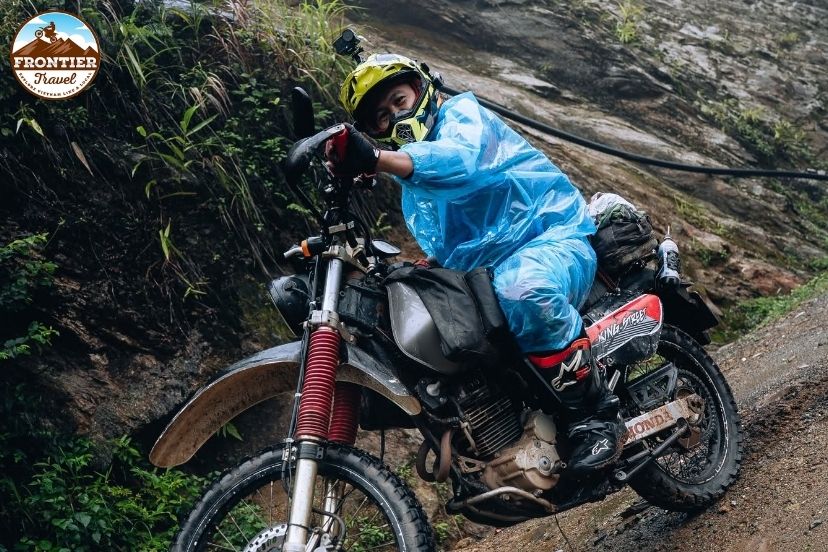
Ascending radical gradients requires the operator to lean their upper torso forward over the fuel tank to keep the front wheel planted firmly. This strategic posture adjustment prevents the motorcycle from shifting too much weight to the rear, which could cause unwanted wheelies.
Riders must keep their knees clamped tightly against the chassis to maintain a rigid connection with the machine. Applying how to ride motorbike mountain passes Vietnam tips in this situation means maintaining a steady throttle opening so the rear tire retains consistent traction against the steep, undulating asphalt roadbed.
1.2. Utilizing low gears to let engine compression control downhill momentum
When dropping down steep alpine loops, operators must select a low gear ratio like second or first gear immediately. Allowing the natural vacuum compression of the cylinder block to regulate your descent speed keeps the vehicle under forty kilometers per hour effortlessly.
This mechanical drag configuration reduces the need to rely on friction brake components, preserving your stopping power for emergencies. Keeping the clutch fully engaged ensures the engine remains connected to the rear wheel, providing continuous deceleration stability.
1.3. Avoiding the fatal mistake of riding your brakes until they overheat
Continuous application of the front and rear brake levers during long mountain drops generates extreme thermal expansion within the calipers. This intense heat causes hydraulic fluid vaporization, leading to a sudden loss of lever pressure known as brake fade.
Motorcyclists should instead employ intermittent braking pulses, squeezing the levers firmly for three seconds before releasing them completely to cool the assemblies. These practical how to ride motorbike mountain passes Vietnam tips ensure your stopping hardware remains fully functional when approaching sharp, unexpected hairpins.
2. Cornering mechanics for sharp highland switchbacks
The dramatic limestone switchbacks found along legendary routes require a highly calculated approach to entry speed management and lane positioning. Developing a systematic cornering routine allows you to flow through tight radii without wandering into oncoming traffic lanes. Frontier Vietnam Travel emphasizes that mastering these cornering dynamics is essential for maintaining total chassis stability throughout your mountain journey.
2.1. Setting your entry speed before the suspension compresses in a turn
Riders must complete all necessary deceleration work and gear shifting before initiating their leaning angle into a mountain curve. Squeezing the front brake lever while entering a turn compresses the front forks, reducing available suspension travel and altering steering geometry unfavorably.
Completing your braking sequence early allows the front forks to rebound naturally, maximizing tire compliance as you lean. Approaching the turn at a conservative pace gives you the necessary reaction time to manage unexpected surface hazards.
2.2. Choosing a wide outer line to maximize visibility around blind curves
When approaching a blind right-hand hairpin, operators should position their motorcycle within the outer two-thirds of their designated lane. This wide entry angle expands your forward line of sight around the rock wall, allowing you to spot oncoming vehicles early.
Conversely, hugging the extreme inner edge of a blind turn leaves you completely blind to oncoming trucks crossing the centerline. Maintaining a central lane buffer provides the necessary lateral space to adjust your path if an obstacle appears.
2.3. Applying smooth throttle delivery at the apex to stabilize the chassis
Once the motorcycle reaches the midpoint of a turn, the operator should apply a smooth, progressive twist to the throttle grip. This gentle acceleration transfers weight back to the wider rear tire, stabilizing the chassis and helping the bike track cleanly out of the corner.
Abruptly snapping the throttle open over loose shale can break rear tire adhesion, triggering an immediate spin out. Maintaining linear control inputs ensures the motorcycle exits the switchback with maximum traction and poise.
3. How to ride motorbike mountain passes Vietnam tips for traffic survival
Surviving the daily flow of highland traffic requires combining technical machine skills with a deep appreciation for local road sharing customs. Reviewing professional manuals detailing how to ride motorbike mountain passes Vietnam tips prepares you to share narrow passages with massive commercial vehicles safely. Adapting your driving style to match these collective habits allows you to move seamlessly through seemingly chaotic transportation corridors.
3.1. Spotting oncoming buses using how to ride motorbike mountain passes Vietnam tips
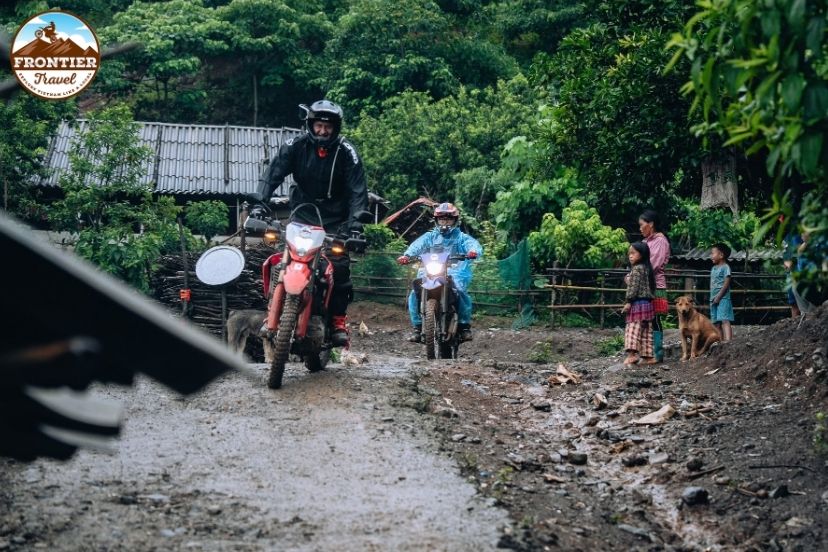
Oversized passenger buses and commercial transport vehicles routinely occupy both lanes when climbing steep mountain curves to preserve their momentum. Motorcyclists must look ahead through the mountain gaps to spot large vehicles descending higher tiers of the pass before they arrive.
Anticipating these wide-turning vehicles allows you to reduce speed and select a safe passing zone along the outer shoulder early. Giving these massive transport units ample operational space prevents dangerous, tight squeezes inside narrow rock corridors.
3.2. Giving uphill heavy transport trucks a wide berth on narrow asphalt
Multi-axle cargo trucks climbing high-altitude slopes move at incredibly slow speeds, often under fifteen kilometers per hour, while emitting heavy diesel exhaust clouds. When trailing these slow-moving vehicles, maintain a generous twenty-meter following distance to stay visible within the driver's side mirrors.
Never attempt to pass a heavy truck until you have a completely clear forward view on a straight highway segment. Applying smart how to ride motorbike mountain passes Vietnam tips means waiting patiently for the truck driver to signal you past.
3.3. Using brief horn taps on blind corners to announce your presence early
Your motorcycle horn functions as an essential acoustic radar system when navigating tight switchbacks where your view is blocked by limestone walls. Emitting two short, sharp horn pulses before entering a blind turn alerts oncoming drivers of your approaching machine early.
This simple warning prompts oncoming traffic to stay within their respective lane boundaries, preventing high-risk head-on collisions. Embracing this local signaling custom represents a highly effective defensive driving strategy for international visitors.
4. Adapting to sudden high altitude environmental changes
A clear morning can transition into a damp, low-traction environment as moisture-laden air masses collide with high limestone peaks. Utilizing verified data regarding how to ride motorbike mountain passes Vietnam tips helps you handle these sudden weather transitions without losing control. Cultivating this tactical patience ensures you preserve your physical comfort and operational safety when environmental conditions deteriorate.
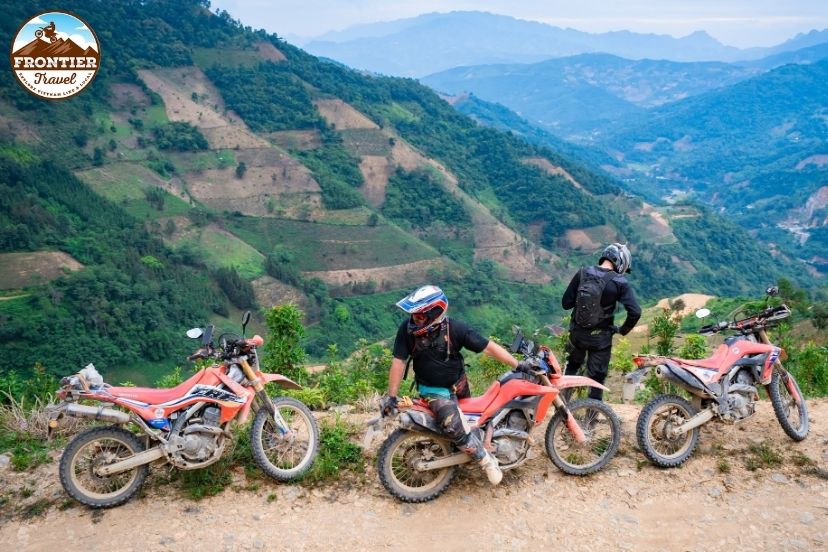
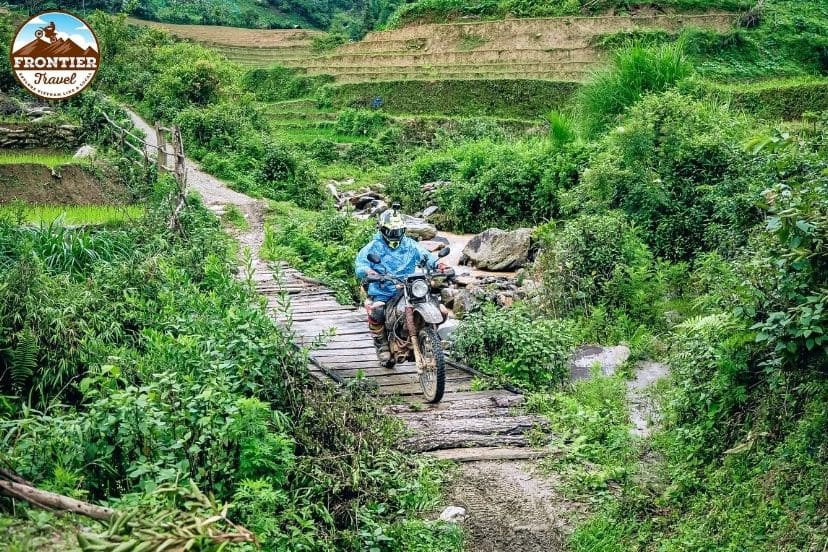
4.1. Reading the texture of the asphalt for hidden moss and wet clay
High-altitude mountain segments that remain shaded by dense cliff faces often harbor thick patches of green moss and slick wet clay. These natural contaminants reduce tire adhesion values by nearly fifty percent, making standard cornering techniques highly perilous for two-wheeled vehicles.
Riders must train their vision to spot dark, damp asphalt discolorations well before making physical contact with the patch. Reducing your leaning angle completely when crossing these low-traction zones prevents sudden, unexpected front-wheel washouts.
When the surface looks darker than the surrounding asphalt, treat it as a warning sign rather than a harmless color change. Keep the bike upright, avoid sudden throttle input, and roll across the patch smoothly before resuming normal cornering speed.
4.2. Safe tracking methods when dropping into thick valleys of whiteout fog
Thermal mountain fog can instantly reduce your horizontal field of vision to less than three meters along high-altitude sections of provincial routes. Under these extreme visibility constraints, you must activate your hazard lights and follow the painted white edge lines closely.
Applying how to ride motorbike mountain passes Vietnam tips in foggy conditions means avoiding the center yellow line, as oncoming drivers may drift across lanes while struggling to find their way through the mist. Utilizing clear, scratch-resistant helmet visors ensures your eyes remain protected while maximizing available light contrast.
If visibility becomes too poor to identify the road edge confidently, slow down immediately and search for a safe pull-off area away from blind curves. Waiting ten or fifteen minutes often allows the fog bank to shift enough for a much safer descent.
4.3. Scanning rock faces for signs of recent shale falls and gravel slides
Saturated mountain slopes along the northern loops represent a major geological hazard that can trigger spontaneous debris flows during the monsoon season. Motorcyclists should apply proactive how to ride motorbike mountain passes Vietnam tips by monitoring the upper cliff faces carefully for trickling red clay or falling small pebbles.
If you encounter a section where fresh mud has breached the roadbed, do not attempt to ride through the unstable mass. Turning back to the nearest secure township remains the only logical choice when facing active geological instability.
Fresh gravel scattered across only one side of the lane usually means the slope above is still releasing loose stones. Cross these sections at walking speed, keep your body relaxed, and never stop directly beneath an unstable rock wall.
5. FAQ on how to ride motorbike mountain passes Vietnam tips smoothly
Embarking on a long-distance journey through complex highland terrain naturally generates important safety and logistical questions among international motorcyclists. Implementing specific answers on how to ride motorbike mountain passes Vietnam tips ensures you stay well ahead of potential geographical challenges before starting your machine.
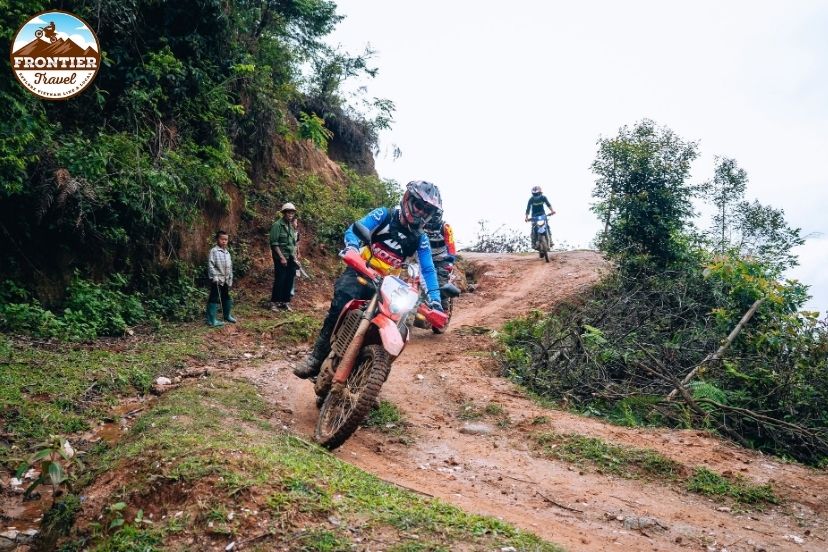
5.1. Which specific mountain pass presents the highest technical difficulty?
The Ma Pi Leng Pass along the Ha Giang Loop is widely considered the most technically challenging route due to its extreme vertical drops and narrow, guardrail-free segments, making it a defining highlight of any Ultimate North Vietnam mountain ride. This legendary pass features over twenty kilometers of continuous switchbacks carved directly into vertical limestone cliffs, requiring absolute concentration from the operator.
Navigating these specific routes demands excellent throttle control, precise body weight management, and a complete lack of vertigo. Utilizing detailed how to ride motorbike mountain passes Vietnam tips ensures you conquer this majestic pass with total poise.
5.2. How do I adjust my riding posture to minimize long distance fatigue?
To minimize long-distance muscular exhaustion, you should maintain a completely relaxed upper torso while keeping your elbows bent loosely. Transfer your body weight directly to your footpegs rather than slumping your spine heavily into the motorcycle seat over bumpy terrains.
Clamping your thighs firmly against the fuel tank provides excellent lateral stability without straining your wrists or lower back muscles needlessly. Taking regular fifteen-minute rest breaks every two hours helps restore circulation and preserves your mental alertness for complex pass segments.
5.3. What should I do if my bike loses power at high elevations?
Standard carbureted motorcycles frequently suffer from rich air-fuel mixtures when ascending past fifteen hundred meters, causing the engine to sputter and lose power. If your machine experiences this high-altitude performance drop, avoid twisting the throttle grip aggressively, which only floods the combustion chamber with excess fuel.
Maintain a steady, partial throttle opening while utilizing a lower gear ratio to keep the engine operating smoothly within its optimal RPM range. Upgrading to a modern, fuel-inserted machine like the Honda XR150L eliminates this specific altitude mapping issue completely.
Conclusion
When you integrate these technical how to ride motorbike mountain passes vietnam tips into your daily rhythm, the daunting switchbacks transform into a fluid, deeply satisfying flow across the landscape. You don't have to test your mountain skills on a weak commuter scooter or guess the safest paths through the peaks. Reach out to Frontier Travel Vietnam today to get matched with high-clearance dual-sport bikes and expert route maps tailored specifically to make your highland crossing seamless, thrilling, and exceptionally safe.