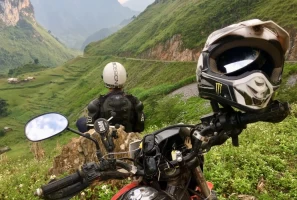
How to read Vietnam mountain road conditions motorbike is essential for every adventurer tackling the breathtaking northern loops. Understanding these elements guarantees safety and enjoyment throughout your journey. Let Frontier Travel Vietnam, the leading provider of Vietnam motorbike tours, equip you with the best bikes and expert knowledge for an unforgettable ride.
1. How to read Vietnam mountain road conditions motorbike safely
Mountain riding safety begins with observation, anticipation, and consistent awareness of changing road environments. Mastering how to read Vietnam mountain road conditions motorbike allows riders to adapt quickly to terrain, traffic, and weather variations without losing control or confidence.
1.1. Identifying mountain traffic signs and speed limits
Riders must constantly interpret warning signs that indicate sharp curves, slippery surfaces, or sudden elevation changes along mountain routes. How to read Vietnam mountain road conditions motorbike becomes critical when recognizing these signs early to adjust speed and positioning safely.
Steep slope warnings and rockfall indicators are especially important in northern highland regions where terrain is unstable. Understanding rural speed limits such as 40 km/h helps maintain safe control on narrow and winding roads.
.jpg)
How to read Vietnam mountain road conditions motorbike for new riders
1.2. Recognizing common road surface materials
Different road surfaces in Vietnam require different levels of traction awareness and riding technique adjustment, especially in mountainous regions where conditions can change within a few kilometers. Riders must quickly assess whether asphalt, clay, or concrete surfaces are safe or risky in real time to maintain stable control.
Wet asphalt can become extremely slippery during sudden mountain rainstorms, significantly increasing braking distance and reducing cornering grip. Clay and dirt roads may quickly transform into deep mud zones after rainfall, requiring smooth throttle control and careful balance to avoid wheel spin or loss of traction.
1.3. Spotting immediate surface hazards
Surface hazards such as gravel, sand, or debris often appear suddenly after trucks pass through rural mountain roads, making constant visual scanning essential for safe riding. Riders must stay alert to rapidly changing surface conditions to anticipate risks before entering unstable sections.
Potholes and drainage gaps can cause sudden wheel deflection if they are not identified early, especially on narrow or poorly maintained routes. Oil spills from passing vehicles create extremely dangerous low-traction zones, particularly on corners where stability is already reduced.
2. Understanding essential terrain types and road surfaces conditions
Terrain awareness is the foundation of safe navigation through Vietnam’s mountainous regions. Developing how to read Vietnam mountain road conditions motorbike helps riders interpret elevation, geometry, and surface complexity effectively.
2.1. Analyzing road design and geometry
Road geometry in mountain areas often includes sharp camber variations that affect tire grip and stability. How to read Vietnam mountain road conditions motorbike allows riders to distinguish between positive and negative camber curves for better control.
Blind corners are common in forested or steep cliffside roads where visibility is limited. Road width changes frequently, requiring constant adjustment of lane positioning and defensive riding techniques.
.jpg)
Understand mountain road geometry for safer riding control
2.2. Managing road elevation changes
Steep ascents require consistent throttle management to avoid engine strain and loss of traction. How to read Vietnam mountain road conditions motorbike becomes especially important when navigating long uphill or downhill stretches safely.
Switchbacks with off-camber angles demand precise balance and controlled braking techniques. Grip levels often vary dramatically depending on slope steepness and surface moisture.
2.3. Dealing with road construction and obstacles
Construction zones are common in developing mountain regions and often leave loose materials scattered across the road. How to read Vietnam mountain road conditions motorbike helps riders anticipate these disruptions and adjust their line early.
Agricultural goods like straw or crops may dry directly on rural roads, creating unexpected hazards. Narrow village paths may also contain sudden obstacles that require immediate reaction and reduced speed.
3. How to read Vietnam mountain road conditions motorbike weather
Weather plays a decisive role in mountain riding safety, often changing rapidly within minutes. Understanding how to read Vietnam mountain road conditions motorbike ensures riders can respond effectively to rain, fog, and landslide risks.
3.1. Coping with heavy rain and dense fog
Heavy rain significantly reduces visibility and increases stopping distance on winding mountain roads. How to read Vietnam mountain road conditions motorbike helps riders adapt their speed and lighting in low-visibility conditions.
Dense fog in high-altitude areas can completely obscure road edges and traffic ahead. Reduced tire grip requires smoother braking and more conservative cornering techniques.
3.2. Identifying landslide and rockfall risks
After heavy rain, mountain slopes become unstable and prone to sudden landslides or rockfalls. How to read Vietnam mountain road conditions motorbike allows riders to identify warning signs such as fresh debris or soil movement.
Visible rock fragments on the road often indicate recent slope activity and high risk ahead. Waiting for safer conditions is often the most responsible decision in such environments.
.jpg)
Identify landslide risks for safer mountain riding decisions
3.3. Navigating flash floods and river crossings
Flash floods can occur quickly in narrow valleys where water flow increases dramatically after storms. How to read Vietnam mountain road conditions motorbike is essential when assessing whether a crossing is safe or dangerous.
Strong currents can destabilize motorcycles even at shallow depths, making crossings extremely risky. Riders should avoid attempting river crossings when water flow is visibly fast or unclear.
4. Common hazards and local traffic on mountain routes
Mountain roads are shared with diverse traffic participants, requiring constant awareness and adaptability. How to read Vietnam mountain road conditions motorbike helps riders anticipate unpredictable movements from vehicles, people, and animals.
4.1. Interacting with large local vehicles
Heavy trucks and sleeper buses dominate many mountain routes and require careful yielding behavior. How to read Vietnam mountain road conditions motorbike ensures riders understand priority dynamics on narrow roads. These vehicles often take wide turns that can encroach into the opposite lane. Maintaining distance and patience is essential for safe coexistence on tight sections.
4.2. Watching out for local residents and children
Villagers frequently use mountain roads for daily activities, often crossing without warning. How to read Vietnam mountain road conditions motorbike helps riders anticipate sudden pedestrian movement in populated areas. Children playing near roadsides may unintentionally move into traffic paths. Reducing speed in villages is a critical safety practice for all riders.
4.3. Encountering free-roaming livestock
Buffaloes, cows, and goats often move freely across rural mountain roads. How to read Vietnam mountain road conditions motorbike is crucial for reacting safely when animals appear unexpectedly. Livestock may remain stationary in blind corners, creating sudden obstacles for approaching riders. Maintaining a safe buffer distance helps prevent collisions.
.jpg)
Watch livestock carefully on rural mountain roads
5. Crucial mountain riding techniques for winding roads
Technical riding skills are essential for maintaining control on Vietnam’s curving mountain roads. Developing how to read Vietnam mountain road conditions motorbike enhances rider precision and decision-making in complex terrain.
5.1. Mastering cornering and vision control
Effective cornering begins with visual awareness that extends beyond the immediate road surface. How to read Vietnam mountain road conditions motorbike supports riders in identifying hazards before entering a curve. Looking toward the exit of a turn improves balance and trajectory control. Proper lane positioning reduces risk of crossing into oncoming traffic.
5.2. Managing speed through corners
Speed control must always be adjusted before entering a curve, not during it. How to read Vietnam mountain road conditions motorbike helps riders determine safe entry speeds based on surface and visibility. A steady throttle through the mid-corner phase maintains stability and traction. Smooth acceleration when exiting ensures better control and momentum.
5.3. Engine braking and gear selection rules
Engine braking reduces reliance on mechanical brakes during long downhill sections. How to read Vietnam mountain road conditions motorbike helps riders select appropriate gears for controlled descents. A balanced braking distribution improves safety and reduces overheating risks. Smooth, pulsed braking ensures better stability on steep gradients.
6. Comprehensive pre-trip preparation and protective gear checklist
Preparation is essential for reducing risk and improving riding confidence in mountainous terrain. How to read Vietnam mountain road conditions motorbike begins long before the journey starts.
6.1. Legal requirements and document checks
Valid documentation ensures smooth travel and avoids legal complications during inspections. How to read Vietnam mountain road conditions motorbike includes understanding regulatory requirements for riding in Vietnam. International Driving Permits must be verified before departure. Rental bikes should always come with proper legal documentation.
It is equally important to confirm that rental agreements are transparent and include all necessary insurance coverage. Carrying proper documents reduces the risk of delays or fines during checkpoints in remote regions. Well-prepared paperwork also gives riders greater confidence when traveling through unfamiliar provinces.
.jpg)
Ensure legal documents ready for mountain riding travel
6.2. Selecting proper safety gear
High-quality helmets and protective clothing significantly reduce injury risk in case of accidents. How to read Vietnam mountain road conditions motorbike also involves preparing for unpredictable weather and terrain. Waterproof gear is essential for sudden rain in highland areas. Proper armor improves rider confidence on technical routes.
Waterproof equipment becomes especially important in northern Vietnam, where sudden rain can appear without warning even on clear days. Proper armor significantly improves rider confidence when navigating technical roads or unstable terrain. Comfortable and well-fitted gear also reduces fatigue during long riding hours.
6.3. Pre-ride motorcycle maintenance check
Tire pressure and brake condition must be checked before every long ride. How to read Vietnam mountain road conditions motorbike includes ensuring the motorcycle is fully operational. Chain tension and clutch responsiveness affect control on steep roads. Functional lights and horns are critical for visibility and communication.
Lighting systems and horns must also be fully functional to ensure visibility and communication with other road users in low-visibility conditions. A well-maintained motorcycle reduces the risk of unexpected breakdowns in remote areas. Consistent pre-ride checks create a safer and more reliable riding experience overall.
7. Choosing optimal motorbikes provided by Frontier Travel Vietnam
Selecting the right motorcycle greatly improves safety and riding comfort in mountain conditions. Frontier Travel Vietnam offers a range of models suited for different terrain challenges.
7.1. Lightweight dual-sport bikes for difficult terrain
Light dual-sport bikes provide excellent maneuverability on rough and narrow mountain paths. Riders learning how to read Vietnam mountain road conditions motorbike benefit from responsive handling and lightweight control. The Honda CRF300L absorbs potholes effectively on uneven terrain. The Yamaha WR155R offers reliable performance for mixed off-road conditions.
These motorcycles are ideal for beginners or riders who prioritize agility over raw power in challenging environments. On guided routes such as the North Vietnam motorbike tour, they offer a confidence-building experience across steep and technical terrain. Their suspension systems also help absorb continuous impacts from potholes and uneven gravel roads.
Light dual sport bikes improve mountain riding control
7.2. Mid-weight adventure bikes for long roads
Mid-weight adventure bikes balance power and stability for long-distance mountain travel. How to read Vietnam mountain road conditions motorbike is easier with stable suspension and controlled throttle response. The Yamaha Ténéré 700 performs well on both paved and unpaved sections. The Honda Transalp 750 ensures comfort during extended mountain rides.
This category is especially popular among experienced riders who want both comfort and performance in one machine. During the North Vietnam motorbike tour, these bikes provide reliable stability across long passes and unpredictable weather conditions. Their versatility makes them a strong choice for riders transitioning from beginner to advanced terrain exploration.
7.3. Large adventure tourers for big challenges
Large adventure bikes provide power and stability for extreme terrain conditions. How to read Vietnam mountain road conditions motorbike becomes crucial when handling heavier machines. The BMW R1250GS delivers smooth performance even on rough surfaces. Advanced suspension systems improve comfort and control significantly.
Their advanced suspension systems and strong braking performance provide extra confidence when carrying heavy loads or riding for extended distances. These machines are often chosen by riders joining premium guided experiences like the North Vietnam motorbike tour, where comfort and endurance are top priorities. With proper control, they offer a smooth yet powerful riding experience even on extreme mountain routes.
8. Conclusion
How to read Vietnam mountain road conditions motorbike is the key to unlocking safe and thrilling adventures. By mastering terrain analysis, weather hazards, and proper riding techniques, you ensure a memorable journey through spectacular landscapes. If you have any questions, do not hesitate to contact Frontier Travel Vietnam for detailed advice on the best motorbikes and itineraries for your trip.